How to Write Blog Titles That Get Clicks
Why the title does most of the work, the patterns that reliably earn clicks, and how to stay compelling without clickbait.
By Mubasher Hussain · Published 2026-07-29 · Updated 2026-09-01 · 1084 words · about 5 minute read
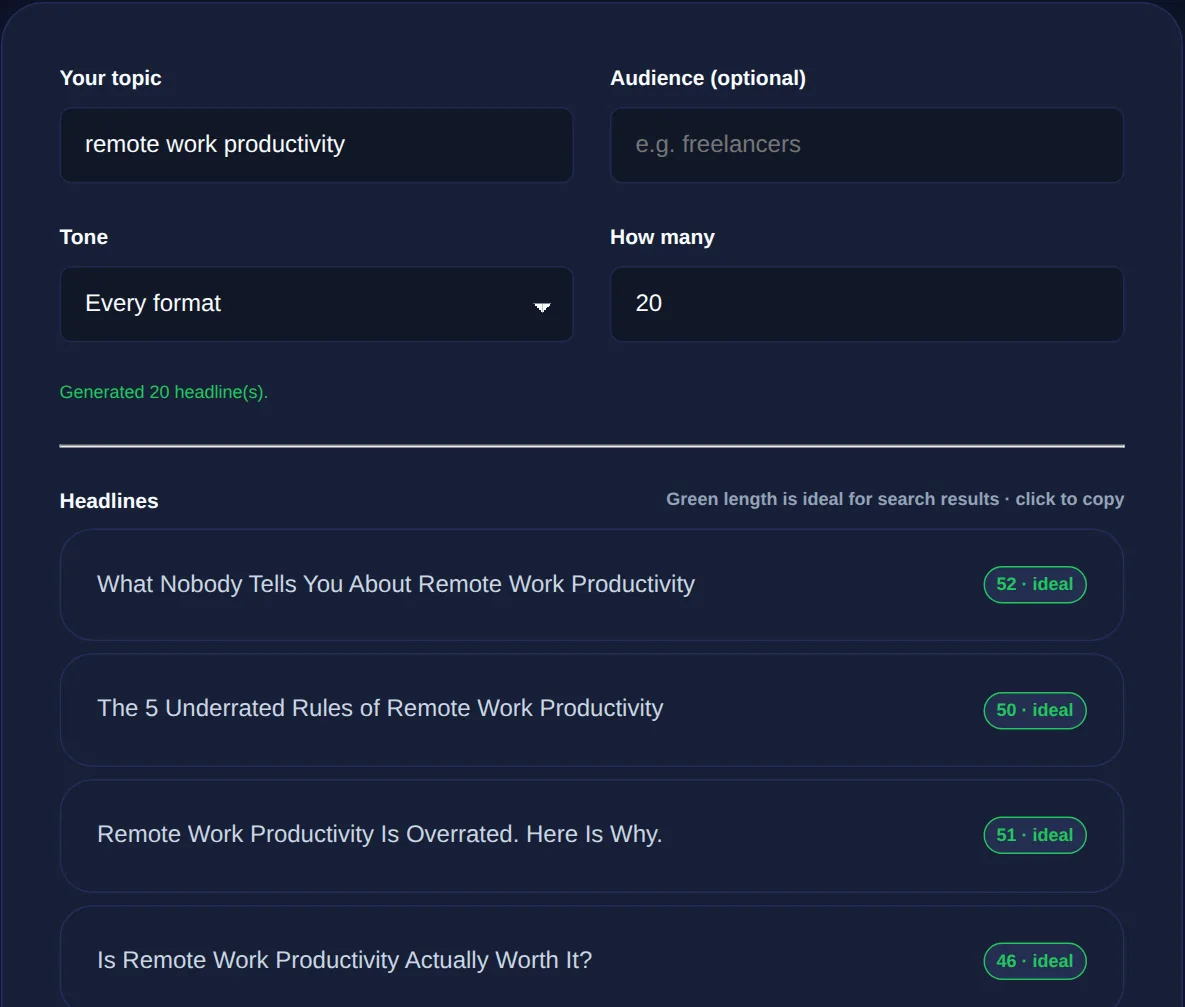
The title is the most important part of any article, because it decides whether the article gets read at all. Most people see your headline far more often than your content, in search results, in feeds, in shared links, and judge in a fraction of a second whether to click. A brilliant article with a weak title goes unread; a solid article with a strong title thrives. The Blog Title Generator helps you brainstorm options in your browser, and this article explains what makes a title work.
Writing good titles is a learnable skill built on understanding what makes people click: a clear promise of value, a touch of curiosity, and specificity that signals the article will actually deliver. The best titles do this honestly, without tipping into clickbait that betrays the reader.
Why the title does most of the work
It is often said that a large majority of people who see a headline never read past it, and while the exact figure varies, the principle is sound: the headline is seen by everyone, the article by a fraction. This means the title is where your effort earns the highest return. A small improvement in your headline's appeal multiplies across everyone who sees it, whereas an improvement buried in paragraph six is seen only by those who already clicked. Spending real time on the title is not vanity; it is where the leverage is.
The patterns that reliably earn clicks
Certain title structures work consistently because they map onto what readers want:
- How-to titles promise a concrete skill: 'How to Write Blog Titles That Get Clicks'.
- List titles promise scannable value and set expectations: '7 Ways to...'.
- Question titles tap curiosity by naming a question the reader has: 'Why Does...?'.
- Specific-benefit titles state exactly what the reader gains.
- Counterintuitive titles challenge an assumption: 'Why More Choice Makes Us Unhappy'.
These are starting points, not formulas to apply mechanically. The pattern provides structure; your specific topic and angle provide the substance that makes a given title genuinely compelling.
'How to Save Money on Groceries' is fine; 'How I Cut My Grocery Bill by a Third Without Coupons' is better, because it is specific and concrete. Specific numbers and details signal that the article contains real, usable substance rather than vague advice.
Curiosity without clickbait
The most effective titles create a small 'curiosity gap', they promise something interesting without giving it all away, so clicking is the natural way to satisfy the curiosity. The danger is pushing this too far into clickbait: titles that exaggerate, mislead, or withhold so much that the article cannot possibly deliver ('You Won't Believe What Happened Next'). Clickbait may earn a click, but it earns a disappointed, distrustful reader who bounces immediately and will not return. Search engines and platforms increasingly punish this, because they measure whether people who click are satisfied. The sustainable approach is an honest curiosity gap: intrigue backed by an article that pays off the promise.
Practical title-writing habits
A few habits produce better titles. Write several, ten or more, for every article rather than settling on your first idea, because the strongest option is rarely the first. Keep titles reasonably short so they are not truncated in search results, checking the length with a character counter. Front-load the most important, interesting words, since titles are often clipped and always skimmed. And say the title aloud: if it sounds awkward or overblown, it will read that way too. Generating a batch of options is a fast way to escape your first, safe idea and find a sharper angle.
Brainstorm a batch of catchy, varied blog title options from your topic, entirely in your browser.
Titles across search and social
Your title does double duty. In search results it is the clickable headline, closely tied to the title and meta tags you set, so it should be both compelling and clear about the topic. On social media it competes in a fast-scrolling feed where intrigue and personality matter more. You can even tune slightly different versions for each context. And the promise the title makes must be kept by the article itself, clear, well-structured writing, checked with a readability checker, is what turns a click into a satisfied reader who trusts you next time.
Testing and learning from your titles
Writing good titles is partly craft and partly feedback. The professionals who consistently produce clickable headlines are not simply more gifted; they pay attention to which of their titles worked and which did not, and they learn from the pattern. Over time you develop an instinct for the angles, words and structures that resonate with your particular audience, because what earns clicks varies by topic and readership, a headline that thrives for a tech blog may fall flat for a cooking site. The only way to build that instinct is to notice results and adjust.
If you have the means, testing two titles against each other on the same content, showing different visitors different headlines and seeing which earns more clicks, removes the guesswork entirely, and large publishers do exactly this routinely. Even without formal testing, you can learn by reviewing which of your published articles drew the most visits from search and social and asking what their titles had in common. The broader mindset is to treat the title as the part of the article most worth iterating on, both before publishing (by generating and weighing many options) and after (by learning from what performed). Because the title carries so much of the responsibility for whether an article is read, this attention compounds: each thing you learn about what makes your audience click makes every future title a little stronger, which over dozens of articles is the difference between work that reliably finds readers and work that depends on luck.
In summary, the title decides whether your work gets read, so it deserves disproportionate effort. Lean on proven patterns, how-to, list, question, specific-benefit, counterintuitive, filled with concrete specifics rather than hype. Create an honest curiosity gap that the article genuinely pays off, keep titles short and front-loaded, and write many options to find the best. A strong, truthful title is the difference between an article that reaches its audience and one that quietly disappears.