How a Countdown Timer Sharpens Focus and Beats Procrastination
Why a visible deadline changes behaviour, the psychology of time pressure, and practical ways to put a countdown to work.
By Mubasher Hussain · Published 2026-07-30 · Updated 2026-10-03 · 1137 words · about 5 minute read

A countdown timer counts down from a set time to zero, showing you exactly how much time remains. That visible, shrinking number turns out to be a surprisingly powerful tool for focus, because a deadline you can see changes how you behave. The Countdown Timer runs one in your browser for any duration, and this article explains why a ticking clock sharpens concentration and how to use it deliberately.
Most of us have noticed that we work faster and more decisively when a deadline looms. A countdown timer lets you harness that effect on demand, creating a small, self-imposed deadline for any task, whenever you want the focus that time pressure brings.
Why a visible deadline changes behaviour
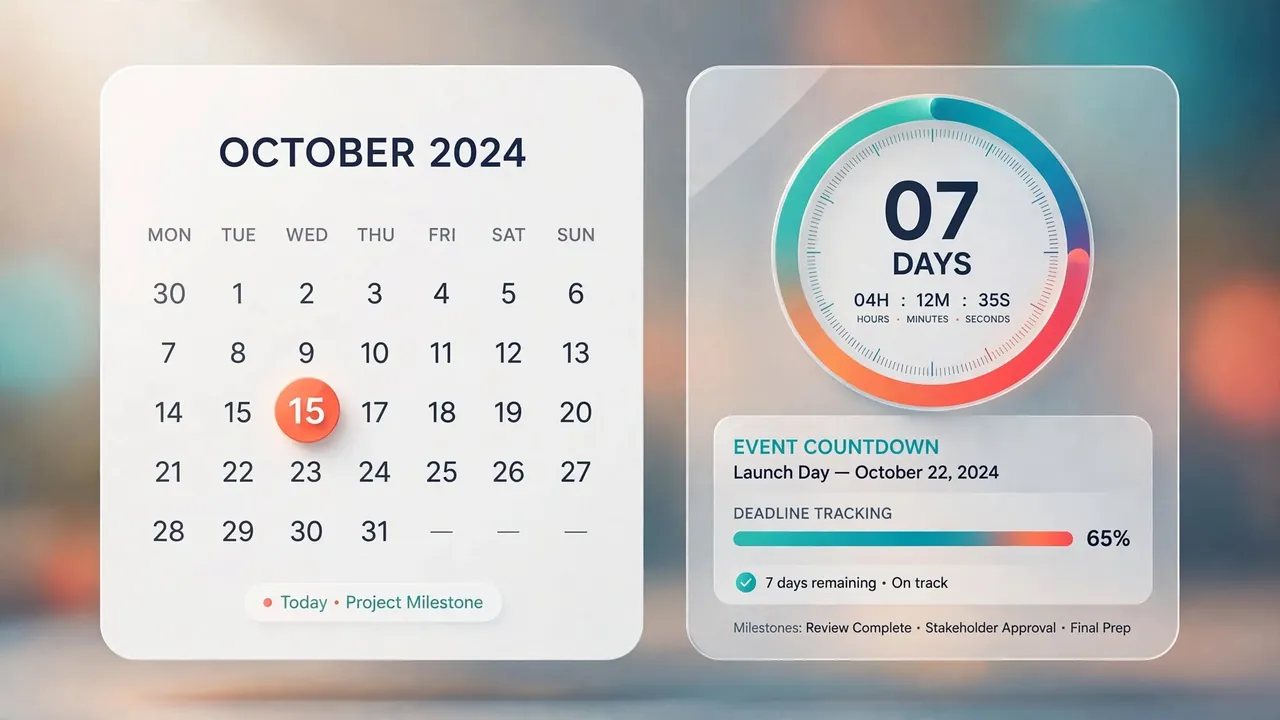
There is a well-known observation that work expands to fill the time available for it: give yourself all afternoon for a task and it takes all afternoon; give yourself an hour and it somehow gets done in an hour. A countdown timer weaponises this. By setting a fixed, visible time limit, you create artificial scarcity of time, which focuses the mind and discourages the drift, perfectionism and distraction that fill an open-ended schedule. The shrinking number makes the deadline feel real and present in a way that a distant, abstract due date never does, and that immediacy is what changes your behaviour in the moment.
The psychology of time pressure
A moderate amount of time pressure is genuinely helpful. It raises your arousal and engagement just enough to sharpen focus, it forces prioritisation because you cannot do everything in the time, and it makes procrastination feel costly because you can literally see the time draining away. The key word is moderate: too little pressure and there is no urgency, but too much, an impossible deadline, tips into stress that harms performance rather than helping it. The art is setting a limit that is tight enough to focus you but realistic enough to achieve, so the pressure motivates rather than panics.
The goal of a countdown is a healthy focus session, not a frantic crunch. Set a limit that makes the task feel urgent but doable. If you regularly hit zero far from finished, your limits are too tight, lengthen them until the pressure helps instead of hurts.
Time-boxing: giving every task a limit
The practical technique built on countdown timers is time-boxing: deciding in advance how long you will spend on a task and setting a timer for exactly that. This does several useful things. It stops any single task from swallowing your whole day. It forces you to work at a task's most important parts first, since you know time is limited. And it makes starting easier, because you are committing to a bounded amount of time rather than an open-ended slog. Time-boxing is especially powerful for tasks that tend to expand, research, editing, tweaking, admin, where without a limit you could tinker forever. Setting a box says 'this gets an hour', and an hour is what it gets.
Practical ways to use a countdown
A countdown timer earns its place across many situations:
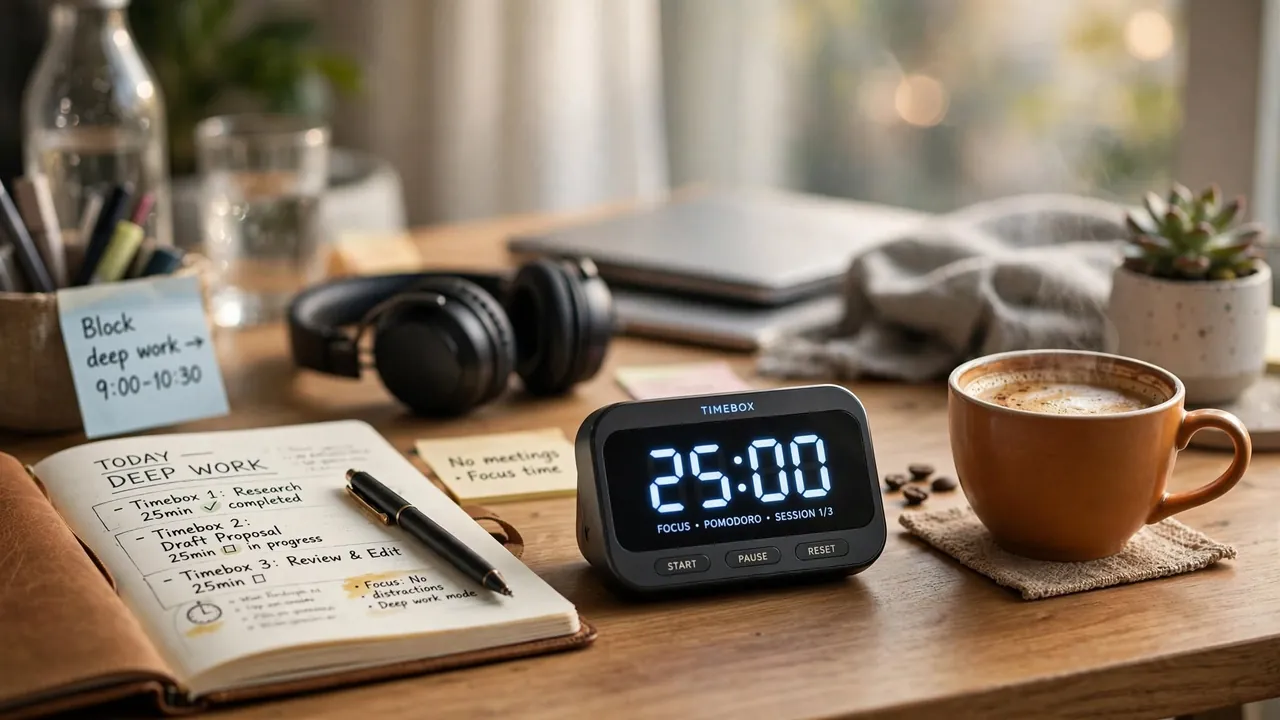
- Focus sessions: give a task a fixed window and work only on it until the timer ends.
- Beating procrastination: tell yourself you will work for just 15 minutes; starting is the hardest part.
- Timed breaks: a countdown ensures a five-minute break does not become thirty.
- Studying and exams: practising under a time limit builds the pacing real deadlines demand.
- Meetings and calls: a visible timer keeps discussions from overrunning.
Set a countdown for any duration to time-box tasks, breaks and focus sessions, entirely in your browser.
Countdowns among your focus tools
A countdown timer is closely related to the other tools for managing time and attention. The Pomodoro Timer is essentially a structured, repeating countdown built specifically for focus sprints; a todo list supplies the tasks you time-box; and for meetings, a meeting cost calculator underlines why keeping to time matters by showing what overruns actually cost. Whichever you use, the underlying idea is the same: a visible limit on time turns vague intention into focused action.
The two-minute rule for starting
One of the most powerful applications of a countdown timer is defeating the initial resistance that keeps tasks undone. The hardest moment of any task is the very start, when the whole thing looms unbegun and your mind manufactures reasons to do it later. A short countdown dissolves this by shrinking the commitment to something trivially small: set a timer for two, five or ten minutes and promise yourself you only have to work until it rings. That promise is easy to accept because the cost is so low, and almost always, once the timer is running and you have begun, you keep going past the bell, because starting, not continuing, was the real obstacle.

This works because motivation often follows action rather than preceding it. We tend to wait to feel like doing something, but for many tasks the feeling only arrives once we have started and gained a little momentum. A countdown flips the order: it gets you started before you feel ready, and the momentum then supplies the motivation. Even on the occasions when you do stop at the bell, you have still made a few minutes of progress on something you might otherwise have avoided entirely, and you have chipped away at the task's psychological weight so the next start is easier. Used this way, a countdown timer is less a tool of time pressure than a tool of activation, a way to trick yourself past the threshold of beginning. Combined with time-boxing for the work itself, the short starting countdown is one of the simplest and most reliable anti-procrastination techniques there is, turning 'I'll do it later' into 'I'll do it for five minutes now'.
To recap: a countdown timer sharpens focus because a visible, shrinking deadline creates useful time pressure, work expands to fill available time, so limiting the time concentrates the work. Moderate pressure raises engagement, forces prioritisation and makes procrastination feel costly, as long as the limit is tight but achievable. Use countdowns to time-box tasks, break procrastination by committing to a short start, and keep breaks and meetings from overrunning. A simple ticking clock is one of the most reliable ways to convert good intentions into finished work.