The Pomodoro Technique: Why Working in 25-Minute Sprints Works
The Pomodoro Technique breaks work into focused 25-minute sprints separated by short 5-minute breaks, with a longer break after four sprints, which protects your attention from distraction and makes big tasks feel manageable.
By Mubasher Hussain · Published 2026-08-02 · Updated 2026-10-08 · 1128 words · about 5 minute read
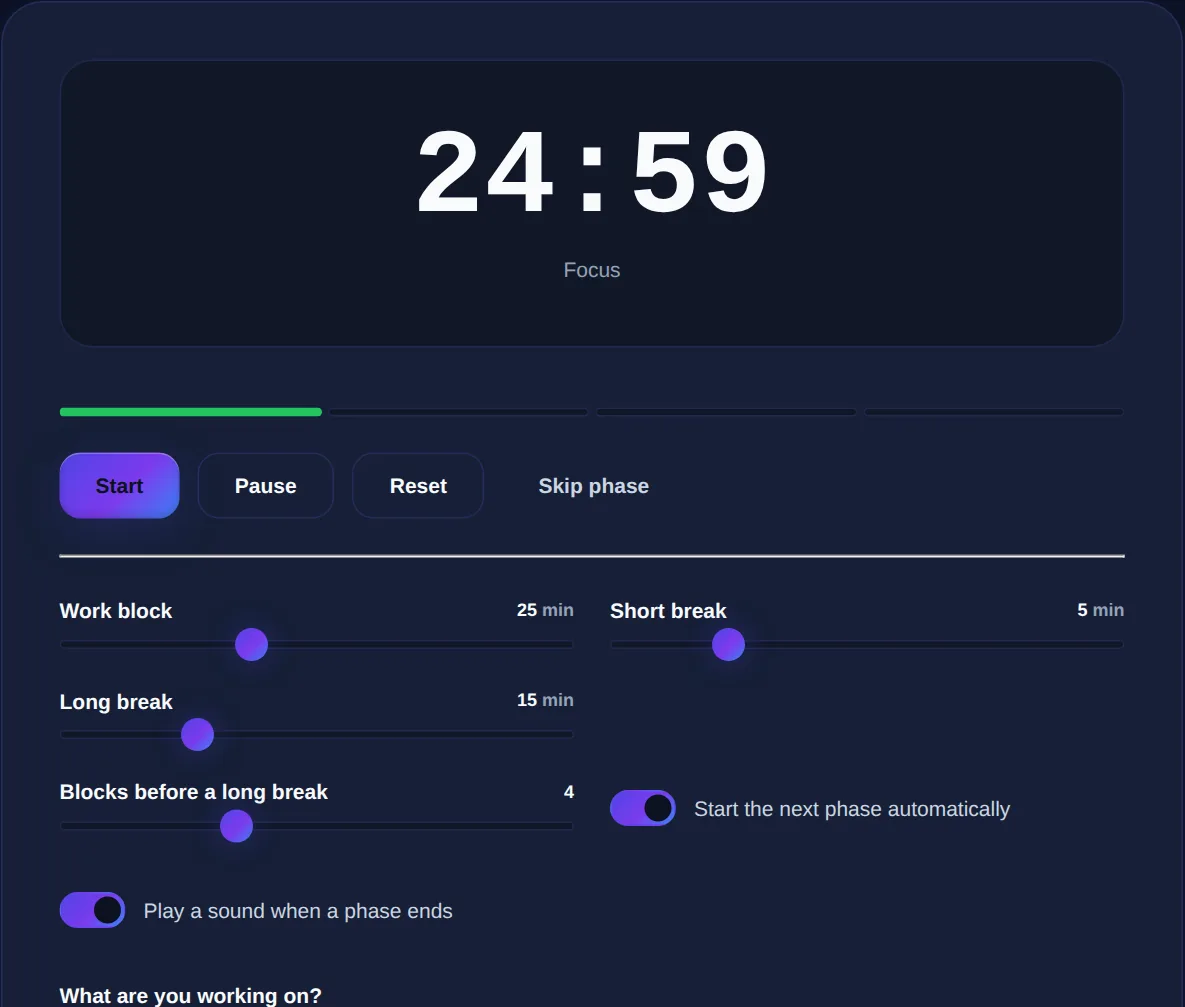
The Pomodoro Technique is a simple time-management method: you work in focused 25-minute sprints, each followed by a short break, and after four sprints you take a longer break. Each 25-minute sprint is called a 'pomodoro', after the tomato-shaped kitchen timer its inventor used. The idea sounds almost too basic to matter, yet it reliably helps people concentrate and get more done. The Pomodoro Timer runs the cycle in your browser, and this article explains why such a simple structure works so well.
The technique's power is that it replaces willpower with structure. Instead of trying to force yourself to focus for hours, you commit to just 25 minutes at a time, a length short enough to feel manageable but long enough to make real progress. That small shift changes everything about how the work feels.
Why a timer beats willpower
Starting is the hardest part of most work, and big, open-ended tasks are the hardest to start because they feel daunting and infinite. A pomodoro shrinks the commitment: you are not sitting down to 'write the report', you are sitting down to work on it for 25 minutes, after which you get a break. That is a far easier promise to keep. Once the timer is running, a second effect kicks in, the ticking clock creates a gentle sense of urgency that crowds out procrastination, and the fixed endpoint makes it easier to resist checking your phone, because you know a break is coming soon. You are borrowing structure from the timer instead of spending scarce willpower.
How the breaks fight distraction and burnout
The breaks are not an afterthought; they are essential to why the method works. The short break after each pomodoro gives your attention a moment to recover, which is what lets you return fresh for the next sprint rather than grinding into diminishing returns. The breaks also give distractions a legitimate home: when an unrelated thought or the urge to check social media arises mid-sprint, you can note it and deal with it in the break, rather than derailing your focus now. Over a longer session, the regular pauses prevent the mental fatigue that builds up during unbroken hours of work, which is the technique's defence against burnout.
The one rule that makes Pomodoro work is that a pomodoro is indivisible: for those 25 minutes you do the one task and nothing else. If an interruption is unavoidable, you end the pomodoro and start a fresh one later. Guarding the sprint is the whole discipline.
Handling interruptions
Interruptions are the enemy of focus, and Pomodoro has a specific way of dealing with them. For internal interruptions, a sudden thought about something else you need to do, you jot it down on a list and return to it later, keeping the thought without acting on it. For external interruptions, a colleague, a message, the aim is to protect the current pomodoro, deferring the interruption to your break where possible. The technique treats interruptions as something to be managed deliberately rather than simply suffered, which builds the habit of noticing just how often your focus is broken and taking back control of it.
Adapting the technique to your work
The classic 25-and-5 rhythm is a starting point, not a law. Different work and different people suit different intervals:
- Deep, absorbing work may flow better in longer sprints of 45 or 50 minutes.
- Tedious or draining tasks can be more bearable in shorter bursts.
- The longer break after several sprints can be 15 to 30 minutes, enough to properly reset.
- What matters is the pattern: focused work, then a real break, repeated.
The right interval is the one you can sustain and that matches your attention span for the task at hand. A flexible timer lets you tune the lengths to what actually works for you.
Run focused work sprints with automatic short and long breaks, entirely in your browser.
Pomodoro within a productivity system
The technique works best alongside a clear sense of what to work on. A todo list tells you which task each pomodoro should tackle, so you never waste a sprint deciding what to do. A habit tracker can help you build the daily habit of doing a few focused sprints, and for tasks with a hard deadline a countdown timer keeps the bigger clock in view. Pomodoro supplies the focus; these tools supply the direction.
Why 25 minutes is the sweet spot
The specific choice of 25 minutes is not arbitrary, though it is not sacred either. It sits in a sweet spot that balances two competing needs. It is short enough that committing to it feels easy and that your attention can realistically stay sharp for the whole stretch, since sustained, high-quality focus is a limited resource that degrades over long unbroken periods. Yet it is long enough to get properly absorbed in a task and make meaningful progress, rather than stopping just as you find your rhythm. A five-minute sprint would be too short to get anywhere; a two-hour one would exceed most people's capacity for unbroken concentration and reintroduce the daunting, open-ended quality the technique is designed to remove.
There is also a psychological neatness to 25 minutes: it is a quarter of an hour past the quarter, an amount of time everyone can picture and few can find an excuse to refuse. That refusability is central, the technique works partly because 'just 25 minutes' disarms the resistance that 'work on this until it's done' provokes. That said, the number is a default to experiment with, not a rule to obey. Some people and some kinds of deep work do better with longer sprints once they are warmed up, while shorter ones suit fatigue or particularly unappealing tasks. The underlying principle, a focused period short enough to start easily and sustain fully, followed by a real break, matters far more than the exact figure. Start with 25, pay attention to when your focus naturally fades, and tune from there.
In summary, the Pomodoro Technique breaks work into focused 25-minute sprints separated by short breaks, replacing the exhausting demand to 'just focus' with an easy, repeatable structure. The short commitment makes starting easy, the ticking timer crowds out procrastination, and the regular breaks preserve attention and prevent burnout. Guard each sprint from interruptions, park distractions for the breaks, and adapt the intervals to your work. It is a deceptively simple method, and its simplicity is exactly why it works, it makes focus a matter of following a rhythm rather than summoning willpower.