Why 20% off plus another 20% off is not 40% off
Two 20% discounts give you 36% off, not 40%. The gap widens as the discounts grow, and the arithmetic is worth knowing before you shop a sale.
By Mubasher Hussain · Published 2026-03-18 · Updated 2026-10-03 · 1115 words · about 5 minute read

A jacket is £200. It is marked 20% off, and there is a promotion offering an extra 20% off sale items. Most people expect to pay £120.
You will pay £128. The two discounts give you 36% off, not 40%.
The arithmetic
Discounts apply sequentially, each to whatever is left after the previous one. They multiply rather than add.
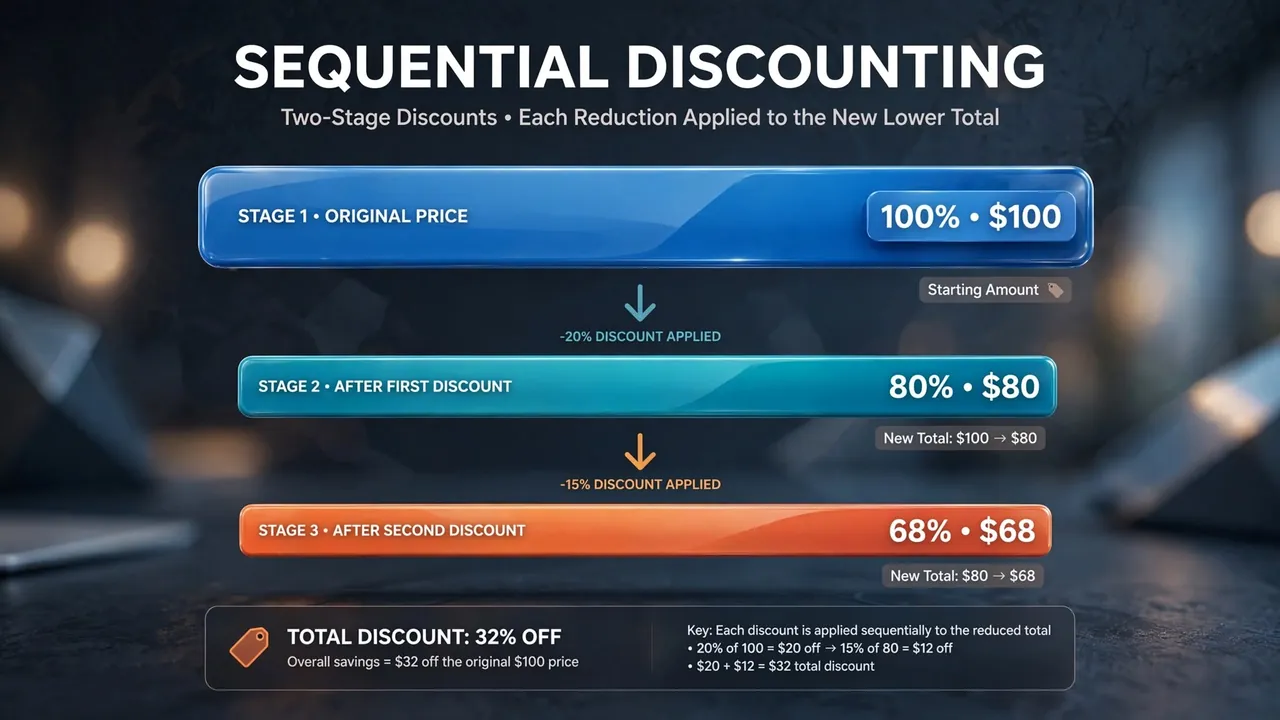
- £200 with 20% off → you pay 80% → £160
- £160 with a further 20% off → you pay 80% of £160 → £128
- £128 out of £200 means you paid 64%, so the effective discount is 36%
The shortcut is to multiply what you pay rather than what you save: 0.8 × 0.8 = 0.64. You pay 64%, so you save 36%.
The gap widens with bigger discounts
| Two discounts | Naive sum | Actual effective discount | Difference |
|---|---|---|---|
| 10% + 10% | 20% | 19% | 1 point |
| 20% + 20% | 40% | 36% | 4 points |
| 30% + 30% | 60% | 51% | 9 points |
| 50% + 50% | 100% | 75% | 25 points |
| 70% + 70% | 140% | 91% | 49 points |
The bottom rows show why the intuition fails so badly at the extremes. Two 50% discounts obviously cannot make something free, you pay a quarter of the original price. And no combination of percentage discounts can ever reach 100%, because you are always taking a fraction of something that remains positive.
Order does not matter
A question that comes up often: does it matter whether the 30% or the 10% is applied first?
Mathematically, no. Multiplication is commutative, so 0.7 × 0.9 and 0.9 × 0.7 both give 0.63. You pay 63% either way.
It does matter when a fixed-amount voucher is involved. £20 off applied before a 50% discount saves you £10 in the end; applied after, it saves the full £20. Retailers specify the order in their terms, and it is almost always the one less favourable to you, percentage discounts first, fixed vouchers last.
Handles single and stacked discounts, works backwards from a sale price to the original, and shows the working so you can check it. Also applies tax after the discount, which is the standard order.
Where tax fits
In nearly every jurisdiction, tax is calculated on the discounted price, not the original. That is the correct order and it works in your favour, a discount reduces the tax you pay along with the price.
In countries where prices are displayed including tax, such as most of Europe, this is invisible to you: the shelf price already includes it and the discount comes off the total. In the US, where sales tax is added at the till, you will see it applied to the reduced amount.
The question worth asking about any sale
All of this arithmetic is secondary to a more basic point: a discount is only meaningful relative to a price the item genuinely sold at.

"Was £200, now £100" tells you nothing if it never actually sold at £200. This practice is common enough that several jurisdictions regulate it directly. EU rules require that a displayed prior price be the lowest price charged in the preceding 30 days. The UK and Australia have broadly similar provisions.
Enforcement is patchy, and the rules generally do not cover items that were briefly listed at a high price before going on permanent sale. The practical defence is to compare against what competitors charge rather than against the number on the label.
Before buying something in a sale, check the current price at two other retailers. That tells you far more than the percentage on the tag does.
Working backwards
Sometimes you know the sale price and want the original. Divide rather than multiply: if something is 30% off and costs £70, the original was £70 ÷ 0.7 = £100.
The common error is to add 30% to £70, giving £91. That is wrong, because the 30% was taken from the larger number, not the smaller one. This is the same asymmetry that makes a 50% rise and a 50% fall not cancel out.
The related trap: percentage rises and falls
A price that rises 20% and then falls 20% does not return to where it started. It ends at 96% of the original, because the 20% fall is taken from the higher number.
The same logic explains something that catches investors out: a portfolio that falls 50% needs to rise 100% to break even, not 50%. Losses require proportionally larger gains to recover, and the effect is severe at large percentages.
How to calculate stacked discounts correctly
The reliable way to combine percentage discounts is to multiply the remaining fractions rather than adding the discounts. A 20% discount leaves you paying 80%, or 0.8 of the price; a further 10% off leaves 90%, or 0.9. Multiply those together, 0.8 times 0.9 equals 0.72, and you are paying 72% of the original, a combined discount of 28%, not the 30% that adding the two figures suggests. The order does not matter: 10% then 20% gives the same 0.72, because multiplication is commutative.
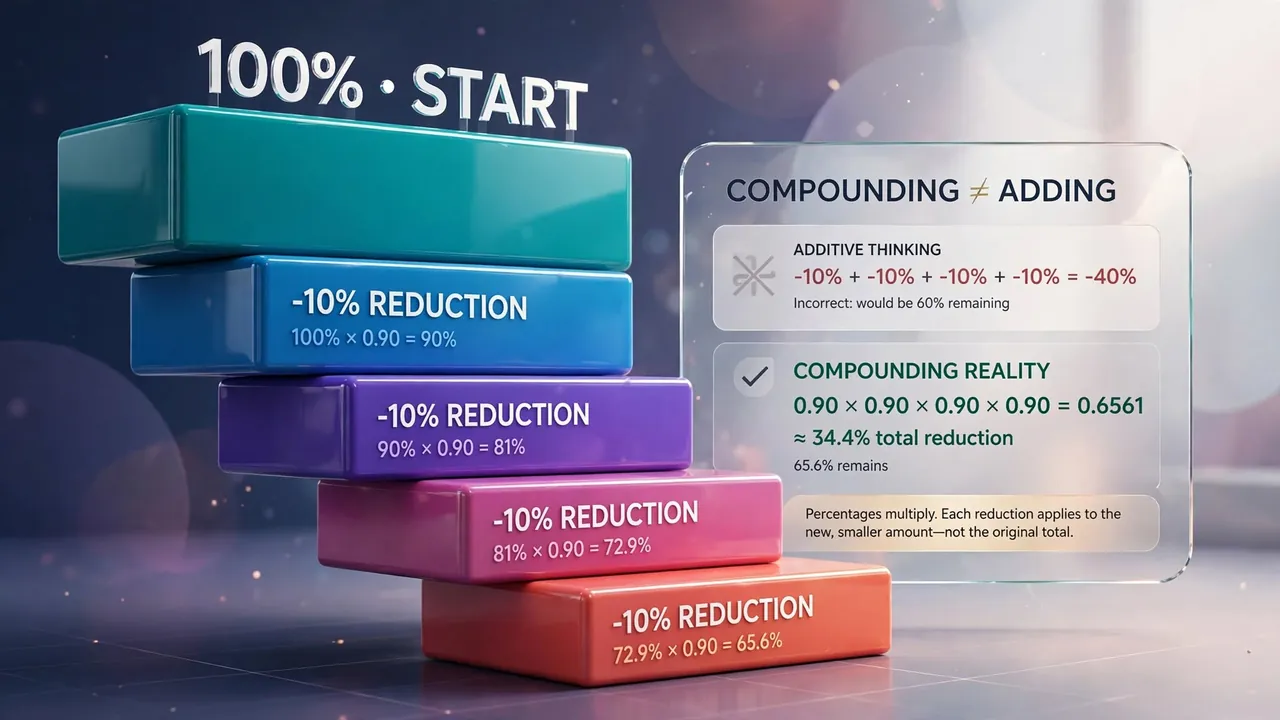
The same logic explains why a discount followed by a tax does not cancel out, and why "an extra 50% off the sale price" is so much less than half off the original. Each percentage always applies to whatever is left after the previous one, never to the starting figure. Whenever you see stacked offers, convert each to the fraction you keep, multiply them, and subtract from one to get the true combined discount, or let a calculator do it so the marketing framing never misleads you.
This is not a trick played on shoppers so much as a consequence of how percentages work, but retailers rarely rush to explain it, because "28% off" sounds weaker than "20% plus an extra 10%." Knowing the maths puts you back in control: whenever offers stack, work out the single equivalent discount before deciding whether a deal is as good as it looks. A few seconds of multiplication is often the difference between a genuine bargain and a clever bit of framing.
None of this is complicated once you see it, but the intuition that percentages simply add is remarkably persistent, and retailers are aware of it.