Generating Secure Keys and Secrets: What Makes a Key Strong
Why keys differ from passwords, what "enough entropy" really means, and how to generate and handle secrets safely.
By Mubasher Hussain · Published 2026-08-01 · Updated 2026-10-03 · 1232 words · about 5 minute read

A key or secret, an API key, an encryption key, a token-signing secret, is a value that protects access to something, and its whole job is to be impossible to guess. Unlike a password you have to remember and type, a key is usually stored by machines, which frees it to be long and completely random. The Random Key Generator produces strong keys in your browser using cryptographic randomness, and this article explains what makes a key strong and how to handle secrets safely.
The single most important property of a good key is unpredictability. A key an attacker can guess, derive or brute-force is no protection at all, however clever the system it guards. Everything about generating a strong key comes down to making it genuinely unguessable.
Why keys are different from passwords
Passwords and keys serve similar purposes but face different constraints. A password must be memorable and typeable by a human, which limits how long and random it can realistically be. A key is stored and used by software, so it has no such limit, it can be a long string of fully random characters that no person could remember, and that is exactly what you want. Because a key does not have to be human-friendly, it should be maximally machine-strong: longer and more random than any password. Treating a key like a password, by making it short or based on a memorable phrase, throws away its main advantage.
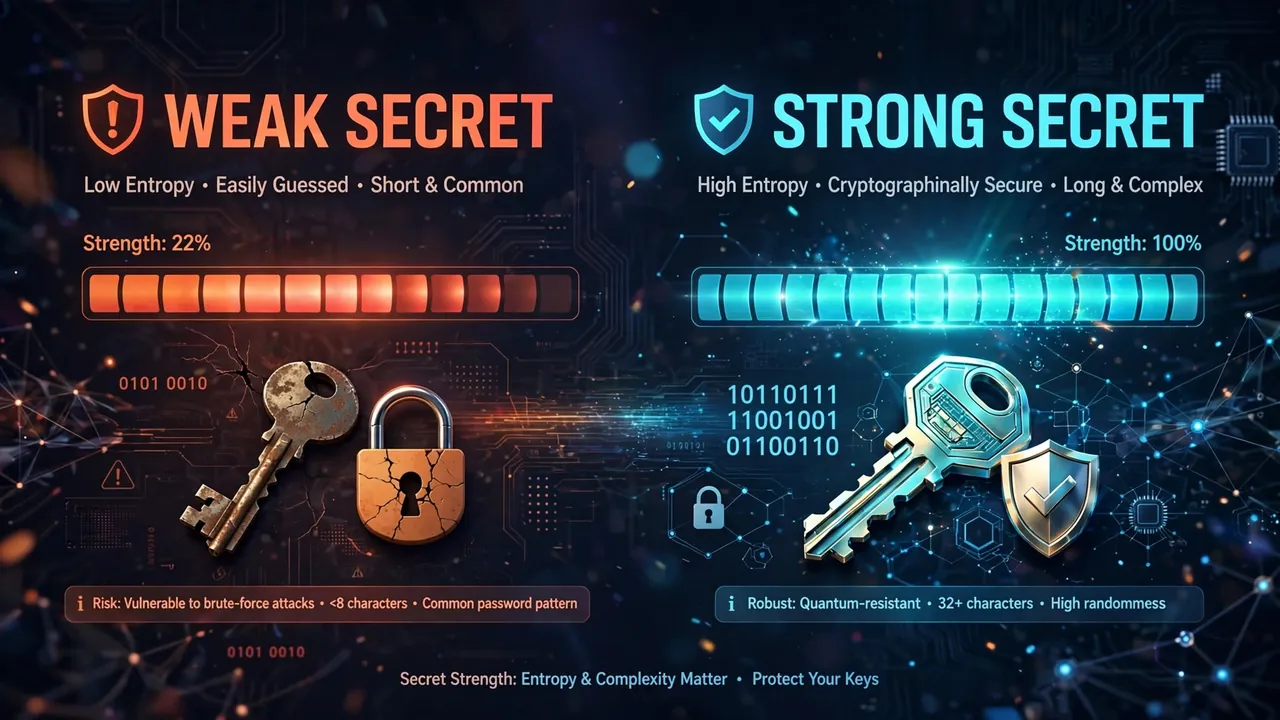
What "enough entropy" means
The strength of a key is measured in entropy, essentially, how many possibilities an attacker would have to try. Each additional random character multiplies the number of possible keys, so a longer key made from a larger character set has astronomically more possibilities than a short one. The goal is enough entropy that brute-forcing the key is computationally infeasible, so many possibilities that trying them all would take longer than any attacker could sustain. In practice this means keys of sufficient length drawn from a wide character set, generated by a source of genuine randomness. Beyond a certain point the key is unbreakable by brute force, and adding length only strengthens it further.
A key is only as strong as the randomness that made it. A key generated from a weak, predictable source can be reconstructed even if it looks random. Strong keys must come from a cryptographically secure random generator, the kind browsers provide, never from a simple pseudo-random function.
Generating a strong key
Producing a strong key comes down to two things: a genuinely random source and adequate length. A good generator draws on the browser's cryptographically secure randomness, the same high-quality source used for the secrets that protect real systems, and lets you choose the length and format. Longer is stronger, so for anything important, favour generous length. The format matters for compatibility: some systems expect hexadecimal, others Base64 or a specific character set, so a flexible generator lets you match what the target system needs. The same secure-randomness principle underpins a password generator, which applies it to human-usable passwords.
- Use a cryptographically secure random source, never a basic pseudo-random one.
- Favour length, every extra random character multiplies the difficulty of guessing.
- Match the format (hex, Base64, custom) to what the consuming system expects.
- Generate a fresh, unique key for each purpose, never reuse one secret across systems.
Generate long, cryptographically secure random keys and secrets in the format you need, entirely in your browser. Nothing is uploaded.
Handling secrets safely
Generating a strong key is only half the job; how you store and handle it matters just as much. A perfectly random key offers no protection if it is committed to a public code repository, pasted into a chat, or hard-coded where others can see it, real breaches happen this way constantly. Keep secrets out of source code and out of anywhere they might be logged or shared, store them in dedicated secret-management systems or environment configuration, and rotate them if you suspect exposure. Because the generator runs entirely in your browser, the key it produces is never transmitted anywhere during generation, it exists only on your device until you deliberately place it where it is needed, which is exactly the control you want over a secret.
It is also worth distinguishing a secret key from an identifier like a UUID. A UUID is unique but meant to be shared openly as a label; a secret key is meant to stay hidden and grant access. Never treat one as the other, a UUID is not a secret, and a secret should not be used as a public identifier.
Rotating and revoking secrets
Generating a strong key is a one-time act, but managing it well is ongoing, and the two practices that matter most are rotation and revocation. Rotation means periodically replacing a key with a fresh one, even if nothing has gone wrong, so that any secret which may have quietly leaked has a limited useful life. Revocation means being able to immediately invalidate a key you know or suspect has been exposed, cutting off access before it can be abused. Systems designed with security in mind make both easy, because the assumption is not that secrets never leak but that, given enough time, some will.

This mindset changes how you treat keys from the moment you create them. A secret should be tied to a single purpose and a single system, so that if it is compromised you can revoke just that one without disrupting everything else, which is exactly why reusing one key across many systems is dangerous, since a single leak then forces you to rotate everywhere at once. It also argues for keeping an inventory of which keys exist, what each protects, and when each was last rotated, so that revocation is a quick, confident action rather than a frantic hunt. Because a browser-based generator produces each key locally and instantly, generating a fresh replacement during rotation costs nothing, and the old one simply stops being used. Treating keys as things that will be rotated and may need revoking, rather than as permanent fixtures set once and forgotten, is what separates a resilient system from one that is merely secure until its first leak. Strong generation gets you a good key; disciplined rotation and revocation keep it that way over the life of whatever it protects.
In summary, a strong key is long, fully random, unique to its purpose, and generated from a cryptographically secure source, free of the memorability constraints that limit passwords. Its strength is measured in entropy, the sheer number of possibilities an attacker would have to try, and enough of it makes brute force infeasible. Generate keys from a proper random source, match the format to the system, use a fresh one per purpose, and store them with care. Do that and your secrets will actually protect what they guard, rather than offering a false sense of security.