How Encryption Works: Keeping Text Truly Private
Encryption scrambles readable text into unreadable ciphertext using a mathematical key, so that only someone with the right key can turn it back into the original, which is how messages, passwords and files stay private even if they are intercepted.
By Mubasher Hussain · Published 2026-08-02 · Updated 2026-10-08 · 1143 words · about 5 minute read
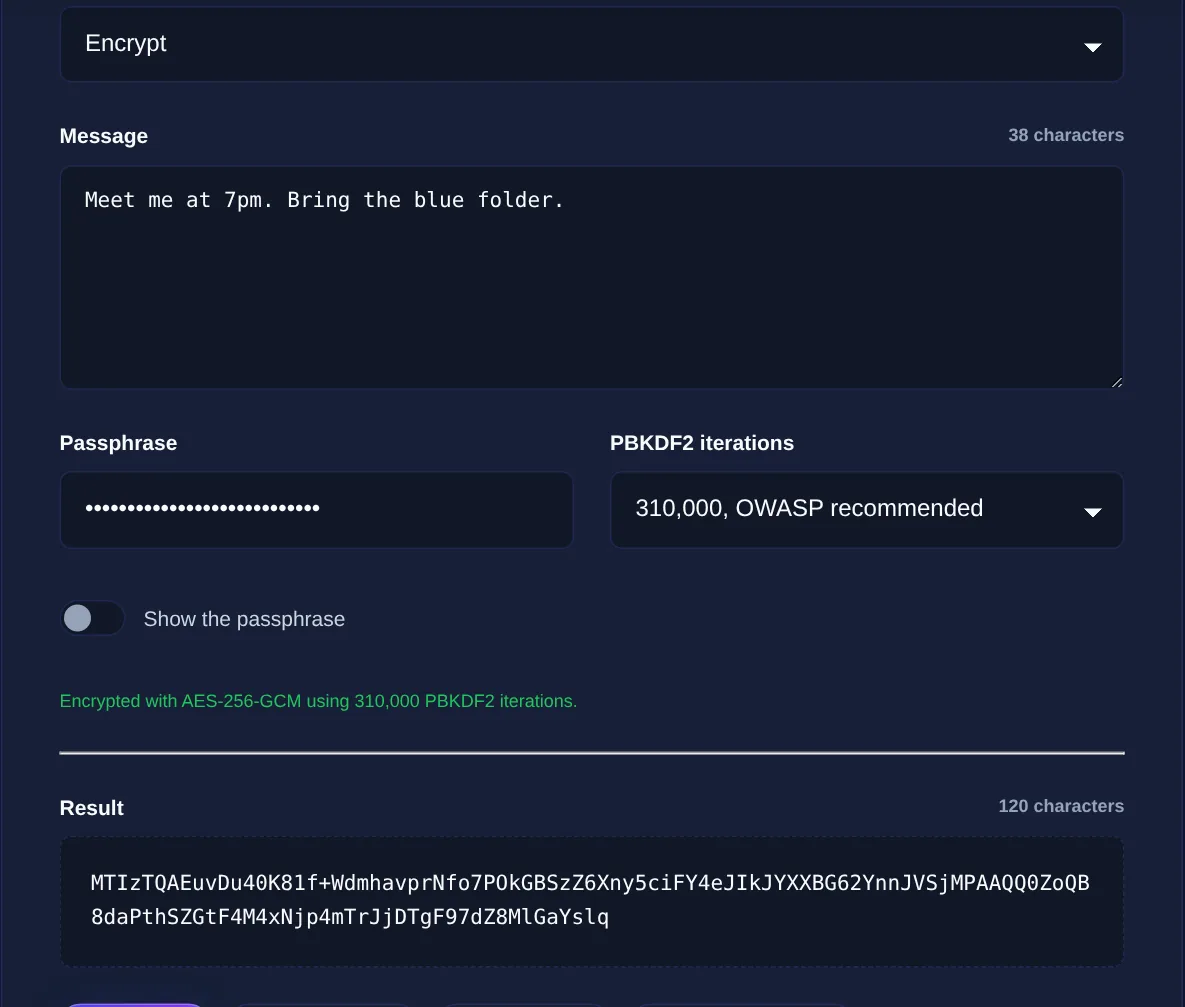
Encryption scrambles information so that only someone with the right key can read it, turning a readable message into meaningless ciphertext and back again. It is what protects your messages, passwords and payments across the internet, and you can use it directly to protect a note, a file or any text. The Encryption Tool encrypts and decrypts text in your browser using a password you choose, and this article explains how encryption works and why where you do it matters.
The crucial distinction to grasp first is that encryption is fundamentally different from encoding. Encoding, like Base64, is a reversible reformatting that anyone can undo. Encryption requires a secret key, and without that key the data is genuinely unreadable, that is what makes it protection rather than mere transformation.
Encoding versus encryption
People often confuse the two, sometimes with dangerous results. Encoding changes the representation of data to make it safe to transport or store, Base64 turning binary into text, for instance, but it hides nothing, because the rules are public and anyone can reverse it. Encryption uses a secret key and a mathematical algorithm to transform data so that reversing it is practically impossible without that key. The presence of a secret is the whole difference: encoded data is open to everyone, encrypted data is open only to key holders. Treating encoding as if it were encryption, thinking Base64 "hides" a password, say, is a real and common security mistake.
How a key protects your data
At the heart of encryption is the key: a secret value that drives the scrambling and unscrambling. A strong modern algorithm is designed so that even if an attacker knows exactly how the algorithm works, and they usually do, since good algorithms are public and well-studied, they cannot recover the original data without the key. The security rests entirely on the secrecy and strength of the key, not on hiding the method. This is why a short, guessable password used as a key undermines even the strongest algorithm: the maths is sound, but a weak key is easy to guess. A strong password or a proper random key is what actually keeps encrypted data safe.
Encryption is only as strong as its key. AES is effectively unbreakable, but if you protect it with the password "1234," an attacker just guesses the password. Use a long, random, unique key or passphrase, the algorithm cannot save a weak one.
Symmetric and asymmetric encryption
There are two broad families of encryption. Symmetric encryption uses the same key to encrypt and decrypt, which is fast and ideal when the same person, or people who can share a secret, need to protect data, encrypting a personal note, for example. The modern standard here is AES, trusted for everything from disk encryption to government secrets. Asymmetric encryption uses a pair of keys, a public one to encrypt and a private one to decrypt, which solves the problem of communicating securely with someone you have never shared a secret with, and underpins secure websites and encrypted email. For protecting your own text with a password, symmetric AES is the right tool.
Encryption is not the same as hashing
One more distinction prevents confusion. Encryption is reversible with the key, you encrypt to later decrypt and read the data. Hashing, done by a hash generator, is a one-way fingerprint that cannot be reversed, used to verify integrity or check passwords without storing them. If you need to get the original text back, you want encryption; if you only need to verify something matches, you want hashing. Choosing the wrong one, hashing data you need to recover, or encrypting a password you should have hashed, is a classic design error.
Encrypt and decrypt text with a password using strong AES encryption, entirely in your browser. Your text and password never leave your device.
Why local encryption matters most
For encryption specifically, doing it in the browser is not a convenience but a security necessity. The entire point of encryption is confidentiality, so if you type your secret text and your password into a website that processes them on its server, you have handed both the data and the key to a third party, completely defeating the purpose. Genuine protection requires that the plaintext and the key never leave your control. A browser-based tool performs the encryption on your own device, so the unencrypted text and the password exist only on your machine, and only the scrambled ciphertext is ever something you might share or store.
Passwords, passphrases and key derivation
When you encrypt text with a password, there is an important step happening behind the scenes that explains why password choice matters so much. Encryption algorithms like AES need a key of a specific size, a fixed-length block of random-looking bytes, not a human password. So the tool runs your password through a key-derivation function, a deliberately slow process that stretches your password into a proper cryptographic key. The slowness is a feature: it makes each guess an attacker tries expensive, which is what stands between a weak password and instant defeat.
This is why a long passphrase beats a short complex password for encryption. Key derivation can only work with the unpredictability you feed it; if your password is short or common, an attacker can try the likely candidates quickly despite the slow derivation, because there are simply not many to try. A long passphrase of several random words has vastly more possibilities, so even a fast attacker cannot exhaust them. The practical lesson is that when a tool asks for a password to encrypt something, you should treat that password as seriously as the encryption itself, because it is the encryption, in effect. Use a long, unique passphrase you have not used elsewhere, and never reuse an encryption password on anything else, since its compromise would expose everything it protects. Strong algorithm, strong key derivation, and a strong passphrase together are what make encrypted text genuinely safe rather than merely scrambled.
To recap: encryption scrambles data with a secret key so that only key holders can read it, which is fundamentally different from encoding, which hides nothing, and from hashing, which cannot be reversed. Its strength depends on the key, so pair a strong algorithm like AES with a long, random key or passphrase. Use symmetric encryption to protect your own text with a password, and always do it locally, because encryption performed on someone else's server surrenders the very secrecy it is meant to provide. Understood and used this way, encryption is a genuinely powerful way to keep information private.