Time Zones Explained: Converting Times Across the World
Time zones divide the world into regions that set their clocks a fixed number of hours ahead of or behind UTC, so converting a time means adding or subtracting the difference between the two zones' offsets, with daylight saving shifting some zones by an hour part of the year.
By Mubasher Hussain · Published 2026-07-26 · Updated 2026-10-08 · 1025 words · about 5 minute read
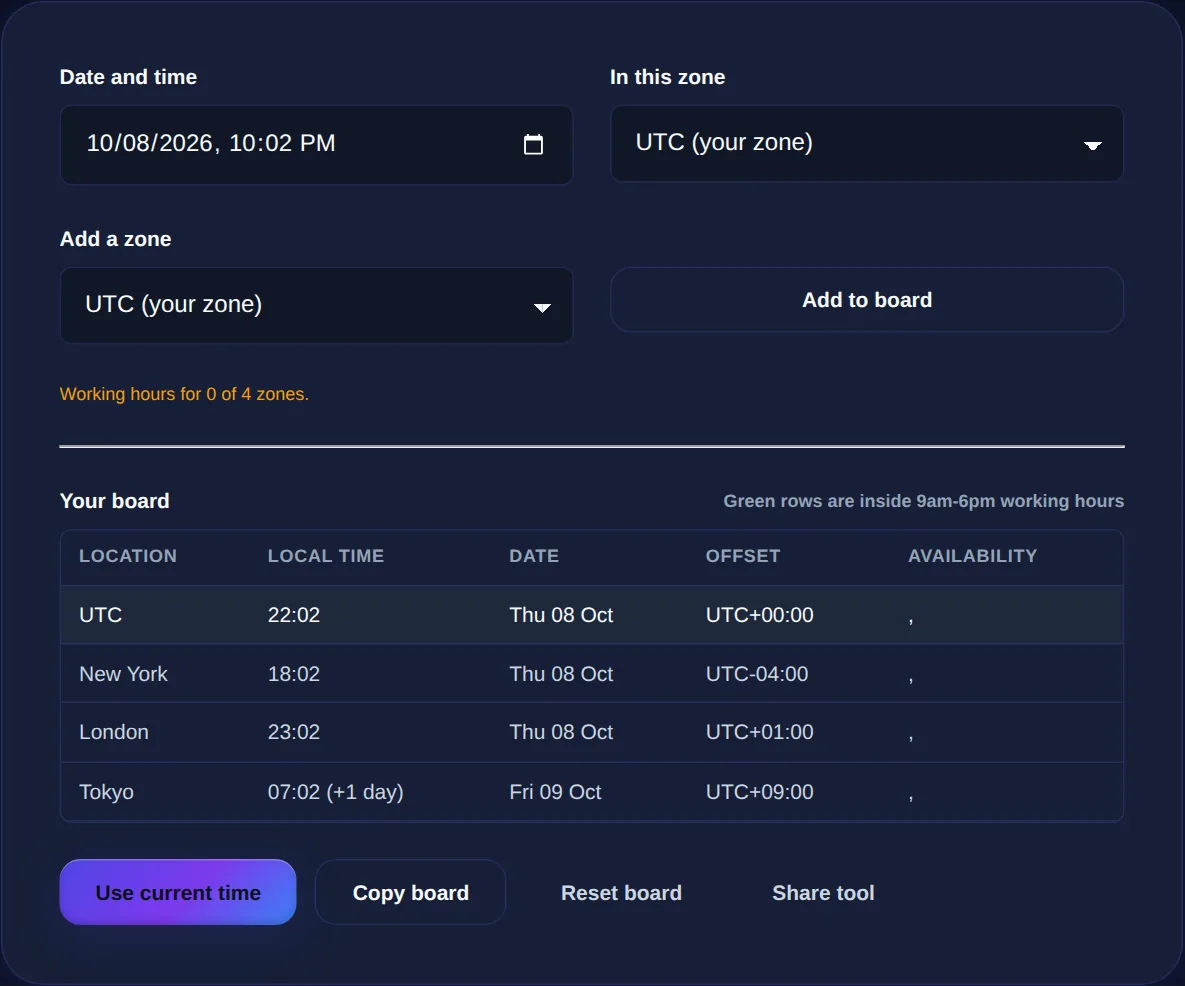
Time zones exist because the Earth rotates, so when it is noon in one place it is midnight on the opposite side of the world. To keep clocks roughly aligned with the sun, the world is divided into zones, each offset from a common reference by a whole (or occasionally half) number of hours. Converting a time from one zone to another means applying the difference between their offsets, with a couple of complications, chiefly daylight saving, that catch people out. The Time Zone Converter does this in your browser.
In a world of remote work, global teams and international calls, converting times correctly is a practical daily skill, and getting it wrong means missed meetings and confused schedules.
Why time zones exist
Before railways and telegraphs, each town kept its own local time based on the sun, which was fine when travel was slow. As fast travel and instant communication spread, this patchwork became unworkable, and the world adopted standard time zones, broad north-south bands, each keeping a uniform time, so that everywhere in a zone shares one clock. The bands are roughly fifteen degrees of longitude wide, corresponding to one hour of the Earth's rotation, though their actual boundaries follow country and regional lines rather than straight meridians.
UTC: the anchor for everything
All time zones are defined by their offset from a single reference: Coordinated Universal Time, or UTC. A zone might be UTC−5, UTC+1, UTC+9 and so on, meaning that many hours behind or ahead of UTC. This makes UTC the anchor that lets any two zones be compared: to find the difference between two zones, compare their offsets from UTC. UTC itself does not change with the seasons, which is why it is the reference used in computing, aviation and international coordination, an unambiguous, fixed backbone against which every local time is defined.
Most time-zone confusion comes from daylight saving time, where clocks shift forward or back by an hour for part of the year, and different regions change on different dates, or not at all. A conversion that was right last month can be an hour off today. Always convert for the specific date in question.
How the conversion works
Converting a time between zones is, in principle, straightforward: find each zone's current offset from UTC and apply the difference. If one city is UTC−5 and another is UTC+1, they are six hours apart, so 9 a.m. in the first is 3 p.m. in the second. The complication is that a zone's offset is not always fixed, daylight saving can shift it by an hour for part of the year, so the correct offset depends on the date. This is exactly why doing the arithmetic by hand is risky and a converter that knows each region's daylight-saving rules is so useful.
Scheduling across zones without mistakes
When you are arranging something across time zones, a few habits prevent errors:
- State the zone explicitly, "3 p.m. Eastern" not just "3 p.m.", so there is no ambiguity.
- Convert for the actual date, since daylight saving may have shifted an offset.
- For recurring meetings, remember that the time difference can change when one region switches daylight saving and another has not yet.
- When in doubt, agree on a UTC time and let each person convert to their own local time.
Convert a time between any world time zones, accounting for daylight saving, entirely in your browser.
Time zones and other time tools
Time-zone conversion connects to the other ways software handles time. A Unix timestamp sidesteps zones entirely by storing an absolute moment in UTC, which you then display in whatever zone you choose, a neat solution to exactly the confusion time zones create. For counting down to an event happening in another zone, a countdown timer helps, and for weighing up whether a cross-zone meeting is worth everyone's odd hours, a meeting cost calculator puts a number on it.
Half-hour zones and other oddities
Time zones are less tidy than the neat one-hour-per-band picture suggests, and the exceptions are worth knowing because they defeat naive mental arithmetic. Several places run on half-hour or even quarter-hour offsets: India is UTC+5:30, parts of Australia use UTC+9:30, and Nepal sits at an unusual UTC+5:45. These exist for geographic and political reasons, and they mean you cannot assume every zone differs from another by a whole number of hours. Anyone scheduling with India or Nepal quickly learns to respect the extra thirty or forty-five minutes that a whole-hour assumption would miss.
There are further wrinkles. Some large countries span many zones, while others, like China, use a single official time across a huge width for the sake of national unity, so the clock can be far out of step with the sun at the edges. A few regions do not observe daylight saving at all, so their difference from neighbours that do shifts twice a year. And the international date line means that crossing it changes not just the hour but the calendar day. All of this is why converting times reliably is genuinely hard to do in your head and why a converter that encodes each region's real rules, its offset, its daylight-saving behaviour, its oddities, is so valuable. The safe mindset is to never assume a zone is a simple whole-hour shift, and to let a tool that knows the exceptions handle anything that matters.
To recap: time zones keep local clocks aligned with the sun by offsetting each region from UTC, the fixed universal reference. Converting a time means applying the difference between two zones' offsets, with daylight saving the main thing that can trip you up, since offsets change with the season and the rules vary by region. State zones explicitly, convert for the specific date, and lean on UTC as the neutral anchor, do that and coordinating across the world stops producing missed calls and midnight surprises.