Morse Code Explained: How to Read, Write and Translate It
Morse code represents letters and numbers as short dots and long dashes. Here is how to read it, the full alphabet, how to write and translate it, and the famous SOS signal.
By Mubasher Hussain · Published 2026-09-09 · Updated 2026-10-03 · 1119 words · about 5 minute read
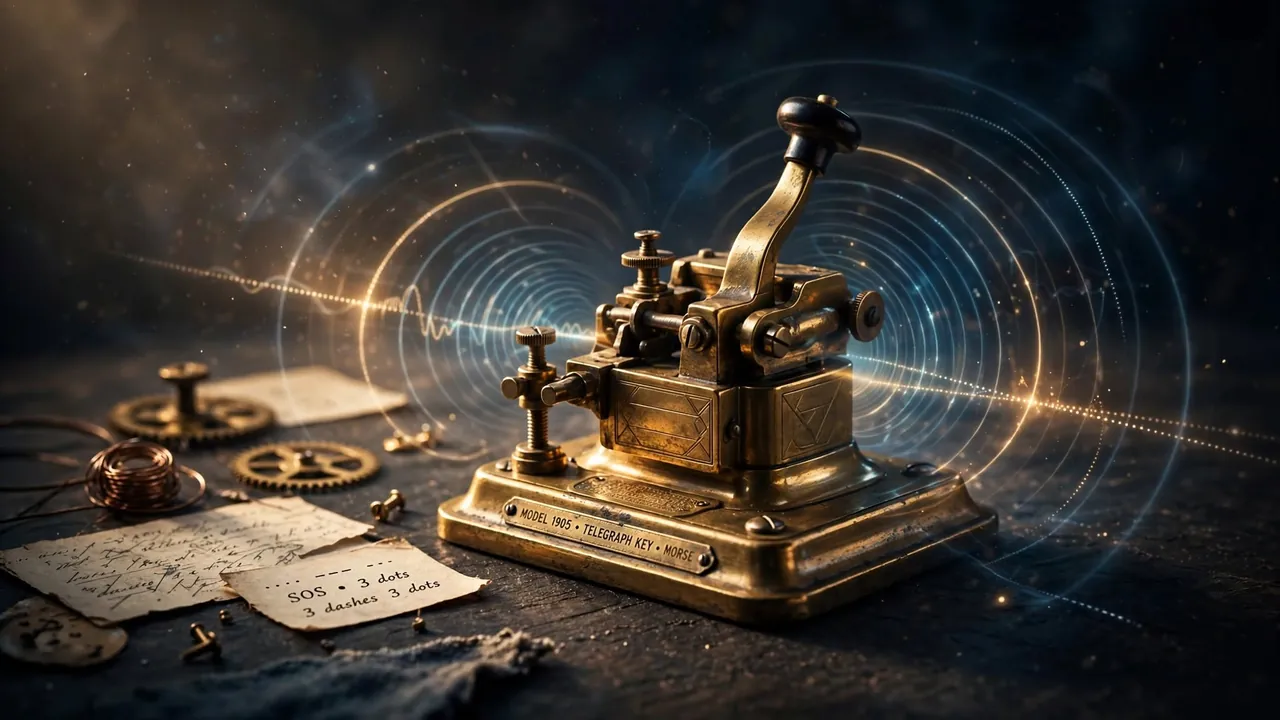
Morse code has been carrying messages for nearly two centuries, from telegraph wires to distress calls at sea, and it still turns up today in aviation, amateur radio and the occasional puzzle. At its heart it is beautifully simple: every letter and number is a short pattern of dots and dashes. This guide explains the alphabet, the timing that makes it readable, and how to translate text to Morse and back. You can hear any message played aloud with the free Morse Code Translator.
What Morse code actually is
Morse code represents text as sequences of two symbols: the dot (a short signal) and the dash (a long one). Samuel Morse and Alfred Vail developed it in the 1830s and 1840s so that messages could travel down a telegraph wire as simple on-off pulses. Because it needs only a single channel that can be switched on and off, Morse can be sent as sound, light, a tapped finger or an electrical pulse, which is exactly why it has survived so long: any medium that can be turned on and off can carry it.

The code was designed cleverly. The most common English letters were given the shortest patterns, so E, the most frequent letter, is a single dot, and T is a single dash. Rare letters like Q and Y get longer patterns. This frequency-based design made real messages faster to send than an evenly-sized code ever could.
The Morse alphabet
Here are the letters and digits. Read the dots as short and the dashes as long; the famous SOS, three dots, three dashes, three dots, appears at the end because it is the clearest example of all.
| Letter | Morse | Letter | Morse |
|---|---|---|---|
| A | .- | N | -. |
| B | -... | O | --- |
| C | -.-. | S | ... |
| E | . | T | - |
| H | .... | U | ..- |
| I | .. | V | ...- |
| K | -.- | W | .-- |
| M | -- | Z | --.. |
Numbers follow a neat pattern of five symbols each: 1 is .---- , 5 is ..... , and 0 is ----- . Punctuation exists too, a full stop is .-.-.- , but letters and numbers cover almost everything you will ever need.
The part everyone forgets: timing
Knowing the patterns is only half of Morse. The other half is timing, because the gaps carry as much meaning as the marks. Everything is measured in one basic unit of time, and the rules are fixed: a dot is one unit, a dash is three units, the gap between symbols within a letter is one unit, the gap between letters is three units, and the gap between words is seven units. Get the spacing wrong and HELLO can dissolve into gibberish even if every individual dot and dash is correct.
This is why written Morse uses spacing conventions: a single space between letters and a slash between words. So HI THERE is written .... .. / - .... . .-. . , and the translator uses exactly that format.
Words per minute: how fast is Morse?
Morse speed is measured in words per minute, and it is standardised using the reference word PARIS, which is exactly 50 units long including its spacing. At 15 words per minute you are sending 750 units every minute, so each unit lasts 80 milliseconds. Raise the speed and every dot, dash and gap shrinks proportionally. Experienced operators comfortably read 20 to 30 words per minute; contest operators go much faster. The translator lets you drag a speed slider so you can start slow and speed up as your ear adjusts.
Convert text to Morse and back, then press play to hear it keyed at any speed while an on-screen light flashes in time. Everything runs in your browser.
How to read Morse by ear
Reading Morse aurally is a skill, not a lookup. The trick experienced operators use is to learn the sound of each letter as a rhythm rather than counting dots and dashes. E is a single tap; A is di-dah; S is di-di-dit. Beginners are often taught with the Koch method, which starts at full speed with just two characters and adds more as each is mastered, and the Farnsworth method, which keeps characters fast but stretches the gaps so your brain has time to recognise each one. Playing messages through the translator at a slow speed, then gradually raising it, mirrors that approach.
Why SOS became the distress signal
SOS, dot dot dot dash dash dash dot dot dot, was chosen as the international distress signal in the early 1900s precisely because it is unmistakable. It is usually sent as one continuous string with no letter gaps, giving a distinctive nine-symbol rhythm that stands out even through noise and interference. Contrary to popular belief it does not officially stand for save our souls or save our ship; those are later backronyms. It was picked for its clarity, not its meaning.
Where Morse is still used
Morse is no longer required for most maritime or aviation licensing, but it has not disappeared. Aviation navigation beacons still identify themselves in Morse, amateur radio operators use it because it punches through weak, noisy conditions where voice fails, and it remains a reliable fallback for emergency signalling with a light or a whistle when nothing else is available. It also endures as a hobby and a puzzle staple, which is where most people meet it today.
Common questions
How do I write a space between words? Use a forward slash surrounded by spaces, so the translator reads it as a word break. Is Morse code case sensitive? No, there is only one set of patterns, so uppercase and lowercase produce the same code. Can I play Morse as sound? Yes, the translator generates correctly timed tones and flashes a light in sync, so you can train your ear and eye together. Is my message private? Yes, the translation and audio run entirely in your browser and nothing is uploaded.

Morse rewards a little practice more than almost any code, because once the rhythms click you can read them anywhere: a flashing light, a tapped table, a beeping tone. Start with the Morse Code Translator at a gentle speed, and when you want to hear text spoken instead, the Text to Speech tool is one click away.