How to Calculate Your GPA: Weighted, Cumulative and by Scale
Why GPA is a weighted average, how credit hours change the maths, the difference between 4.0, 4.3 and 5.0 scales, and how to work out your cumulative GPA.
By Mubasher Hussain · Published 2026-09-09 · Updated 2026-09-01 · 1018 words · about 5 minute read
Your grade point average is one number that summarises years of work, and yet most students are unsure exactly how it is calculated. The key thing to understand is that GPA is a weighted average, not a simple one: a top grade in a heavy course counts for far more than the same grade in a light one. This guide walks through the formula, the role of credit hours, the different grading scales, and how cumulative GPA builds up over time. You can check any of it with the free GPA Calculator.
Step one: turn letter grades into points
Every letter grade maps to a number of grade points. On the standard American 4.0 scale, an A is worth 4.0, a B is 3.0, a C is 2.0, a D is 1.0 and an F is 0.0, with plus and minus grades filling the gaps (an A- is 3.7, a B+ is 3.3, and so on). This mapping is the foundation of everything: before any averaging happens, each of your grades becomes a point value.
| Grade | Points | Grade | Points |
|---|---|---|---|
| A / A+ | 4.0 | C | 2.0 |
| A- | 3.7 | C- | 1.7 |
| B+ | 3.3 | D+ | 1.3 |
| B | 3.0 | D | 1.0 |
| B- | 2.7 | F | 0.0 |
Step two: weight by credit hours
This is the step people miss. Courses are not equal, a four-credit core class represents far more work than a one-credit seminar, so it should influence your average more. GPA handles this by weighting each grade by its credit hours. For each course you multiply its grade points by its credits to get quality points, then you add up the quality points across every course and divide by the total number of credits. That division by total credits is what makes it a weighted average rather than a plain one.
The formula in words: GPA equals total quality points divided by total credit hours, where quality points for a course equals grade points times credits.
A worked example
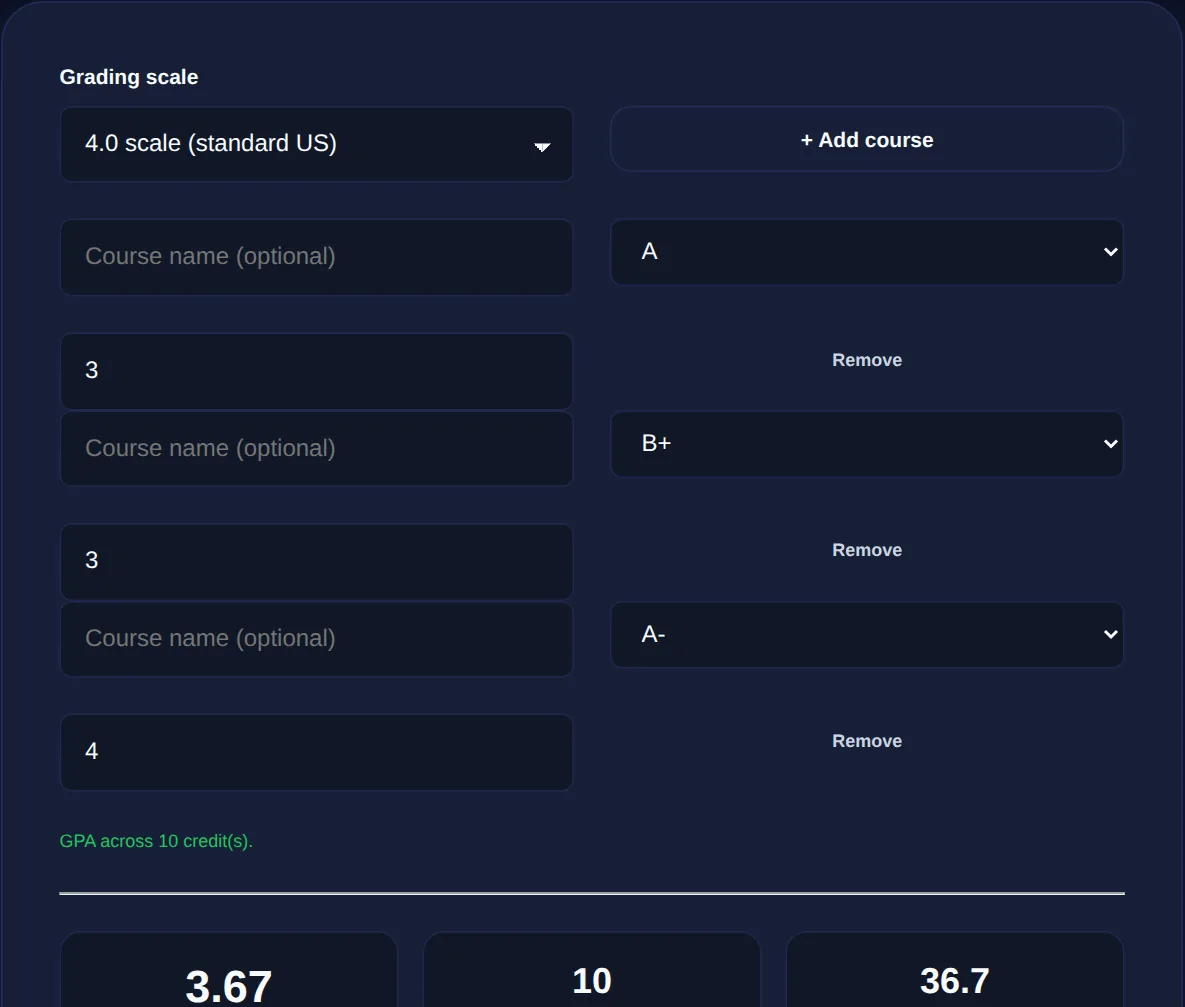
Suppose you take three courses: an A in a 3-credit class, a B+ in a 3-credit class, and an A- in a 4-credit class. Convert and weight each one: the A gives 4.0 times 3, which is 12.0 quality points; the B+ gives 3.3 times 3, which is 9.9; the A- gives 3.7 times 4, which is 14.8. Add the quality points: 12.0 plus 9.9 plus 14.8 is 36.7. Add the credits: 3 plus 3 plus 4 is 10. Divide: 36.7 divided by 10 is a GPA of 3.67.
Notice that the A- in the four-credit course pulled real weight, more than either three-credit result, because it carried more credits. That is the whole point of weighting, and it is why two students with the same letter grades can end up with different GPAs if their course credits differ.
Add each course with its grade and credits and get your weighted GPA instantly, on the 4.0, 4.3 or 5.0 scale. Nothing is saved or uploaded.
Weighted GPA and the 5.0 scale
There is a second, separate meaning of weighted GPA that causes confusion. So far, weighted has meant weighted by credit hours, which every GPA is. But many high schools also use a weighted scale that awards extra points for harder courses: an A in a regular class is 4.0, but an A in an honours or Advanced Placement class might be 4.5 or 5.0. This rewards students for taking a tougher load and is why some high-school GPAs exceed 4.0. If your school does this, choose the 5.0 scale in the calculator so an A in an advanced course scores correctly.
The 4.3 scale and the A-plus question
Institutions also disagree on whether an A+ is worth more than an A. On the most common 4.0 scale, A and A+ are both capped at 4.0. On a 4.3 scale, an A+ is worth 4.3, which slightly rewards perfection. Neither is more correct; they are just different conventions, and your transcript follows your institution's choice. The calculator lets you pick the scale so the result matches your official record rather than a generic default.
Cumulative GPA: adding up over time
Your GPA for a single term is a semester GPA. Your cumulative GPA is the same calculation applied across every course you have ever taken: all quality points divided by all credit hours. It is not the average of your semester GPAs, that would be wrong, because it would ignore how many credits each term carried. A light term with a high GPA moves your cumulative figure less than a heavy term with the same GPA. The reliable way to track it is to keep adding every course to the same calculation, which is exactly how the tool builds a running total of credits and grade points.
Because the maths is transparent, you can enter the grades you expect next term alongside your current courses to see where your GPA would land. It turns the calculator from a report card into a planning tool.
Common questions
Is cumulative GPA the average of my semester GPAs? No. It is total quality points over total credits across all terms, which correctly weights bigger terms more. Do pass or fail courses count? Usually not toward GPA, since they have no grade points; check your institution's policy and simply leave them out. Why is my weighted GPA above 4.0? Because a weighted scale adds points for honours or AP courses. Is my data private? Yes, everything is calculated in your browser and nothing is stored online.
GPA feels mysterious only until you see the two moving parts: grades become points, and points are weighted by credits. Once that clicks, you can calculate, check and plan your average with confidence. Keep the GPA Calculator handy each term, and use the Percentage Calculator when you need to convert an individual grade to or from a percentage.