Why You Need Fake Data for Testing (and How to Generate It)
Why realistic test data beats "asdf," the privacy reasons never to test with real records, and what good fake data looks like.
By Mubasher Hussain · Published 2026-07-27 · Updated 2026-09-01 · 1080 words · about 5 minute read
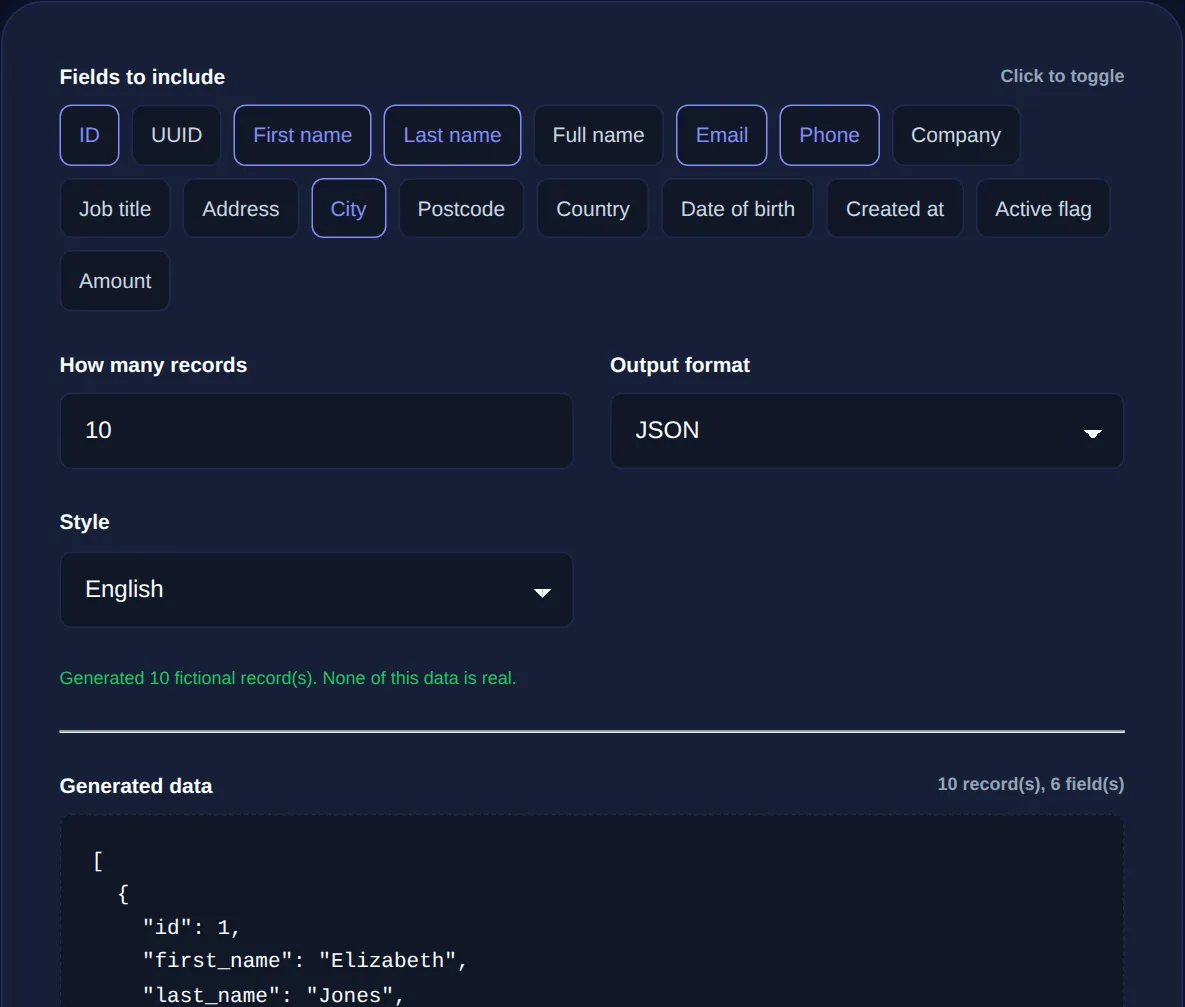
Fake data is realistic-looking but entirely invented information, names, emails, addresses, phone numbers, dates, used to test software without touching real personal records. Anyone building or demonstrating an application needs it, because you cannot properly test a user table with three rows of "asdf," and you should never test with real customer data. The Fake Data Generator produces convincing test records in your browser, and this article explains why fake data matters and what makes it good.
Testing with realistic data reveals problems that lazy placeholders hide, while using invented rather than real records keeps you on the right side of privacy law and good practice.
Why "asdf" is not enough
Typing junk like "asdf" or "test test" into a form to check it works is tempting, but it hides the very problems testing is meant to catch. Real names have varying lengths, apostrophes and hyphens; real emails have diverse formats; real addresses span multiple lines and countries. A layout that looks fine with "asdf" may break with a genuinely long name, a name containing an apostrophe (which can also cause bugs if input is handled carelessly), or an address that wraps to three lines. Realistic fake data stresses your interface and your code the way real users will, surfacing issues while they are still cheap to fix.
The privacy reason never to use real data
There is a stronger reason to use fake data than convenience: using real personal data for testing is a privacy and legal hazard. Copying a slice of your production customer database into a test or demo environment spreads real people's personal information into places with weaker protections, more access and less oversight, a common cause of data leaks. Privacy regulations treat personal data seriously wherever it lives, including test systems. Generating fake data sidesteps the whole problem: invented records carry no privacy risk, can be shared freely with a wider team, and can be committed to a repository or used in a public demo without exposing anyone.
Good fake data looks completely plausible, a believable name paired with a matching email and a valid-format phone number, yet corresponds to no actual person. That combination of realism and total safety is exactly what makes it useful for testing and demos.
What realistic fake data covers
The value of a fake data generator is in producing coherent, believable records across many field types:
- Names of varied length and structure, including ones with apostrophes and hyphens.
- Emails in realistic formats, often matching the generated name.
- Addresses with streets, cities, postcodes and countries.
- Phone numbers in valid-looking formats.
- Dates, such as birthdays or signup dates, within sensible ranges.
- Other fields like company names, job titles and IDs.
The best fake data is internally consistent, the email plausibly relates to the name, the postcode matches the city, because inconsistent data can itself cause confusing test results.
Using fake data across the stack
Fake data supports many tasks beyond filling a form. It populates a database so you can test performance and pagination with realistic volume. It fills a spreadsheet or a demo so a product looks alive rather than empty. It provides input for automated tests that need varied, repeatable records. Generated as a table, it can be converted with a CSV to JSON tool to feed an API or a front end. Alongside placeholder text and placeholder images, it completes a realistic mockup where every element, text, images and data, is convincing without being real.
Generate realistic fake names, emails, addresses and more for testing and demos, entirely in your browser. Nothing is uploaded.
Fake data done right
A few habits make fake data most useful. Generate enough of it to test realistically, a handful of rows will not reveal pagination or performance issues that appear with hundreds. Include awkward but valid cases deliberately: very long names, international characters, addresses with multiple lines, so your software is tested against the edges real users will bring. And keep test data clearly separate from real data so the two never mix. Because the generator runs in your browser, you can produce as much as you need instantly and privately, with nothing uploaded.
Generating data that matches your real shape
Fake data is most useful when it mirrors the structure and variety of the real data your system will handle, so a little thought about shape pays off. If your application stores users with names, emails, countries and signup dates, generate fake records with exactly those fields, in realistic proportions, a spread of countries, a range of dates, names from varied backgrounds. Data that is too uniform hides bugs that only appear with diversity, such as a layout that breaks on a long name or a sort that misbehaves with mixed cases and characters. The closer your fake data resembles the messy reality of real input, the more problems it will catch before your users do.
Volume and edge cases deserve deliberate attention too. Generate enough records to exercise pagination, scrolling, search and performance, a few rows will never reveal the issues that appear at hundreds or thousands. Then seed in the awkward cases on purpose: the maximum-length name, the address with several lines, the international phone number, the name containing an apostrophe, the empty optional field. These are exactly the inputs that expose brittle handling, and including them in your test data means your software meets them in a controlled test rather than in front of a real user. Because you can generate as much realistic data as you like instantly and privately in the browser, there is no reason to test thin, build a dataset that looks and behaves like the real thing, edges and all, and let it stress your application properly before launch.
To sum up: realistic fake data is essential for testing and demos because it exposes the layout and handling problems that junk input hides, while carrying none of the privacy and legal risk of real personal records. Good fake data is plausible, internally consistent and generated in enough volume to test properly. Use it to fill forms, databases, spreadsheets and mockups, include the awkward cases on purpose, and never reach for real customer data when invented data does the job safely.