The Real Cost of Meetings (and How to Calculate It)
The real cost of a meeting is roughly every attendee's hourly pay multiplied by the length, so a one-hour meeting with eight well-paid people can quietly cost hundreds of dollars, which is why fewer, shorter and smaller meetings pay off.
By Mubasher Hussain · Published 2026-07-28 · Updated 2026-10-08 · 1149 words · about 5 minute read
Meetings feel free because no money visibly changes hands, but they are one of the largest hidden costs in any organisation. The real cost of a meeting is the combined value of everyone's time spent in it, and once you add that up, a routine hour-long meeting with a handful of well-paid people turns out to be startlingly expensive. The Meeting Cost Calculator puts a number on it in your browser, and this article explains why that number matters and how it changes behaviour.
The purpose of pricing a meeting is not to abolish meetings, many are genuinely valuable, but to make their cost visible, so that the decision to hold one, and how to run it, is made with the true price in mind rather than as if time were free.
Why meetings cost more than they seem
The cost of a meeting is simple in principle: it is the number of attendees multiplied by the length of the meeting multiplied by the value of each person's time. What makes it surprising is how quickly that multiplies. An hour feels like an hour, but an hour-long meeting with ten people is not ten hours of cost to notice, it is ten person-hours consumed at once, all charged against the same sixty minutes. Add senior salaries and the figure climbs fast. Because the cost is spread invisibly across many people's time rather than appearing as a single bill, it is easy to ignore, which is exactly why meetings proliferate.
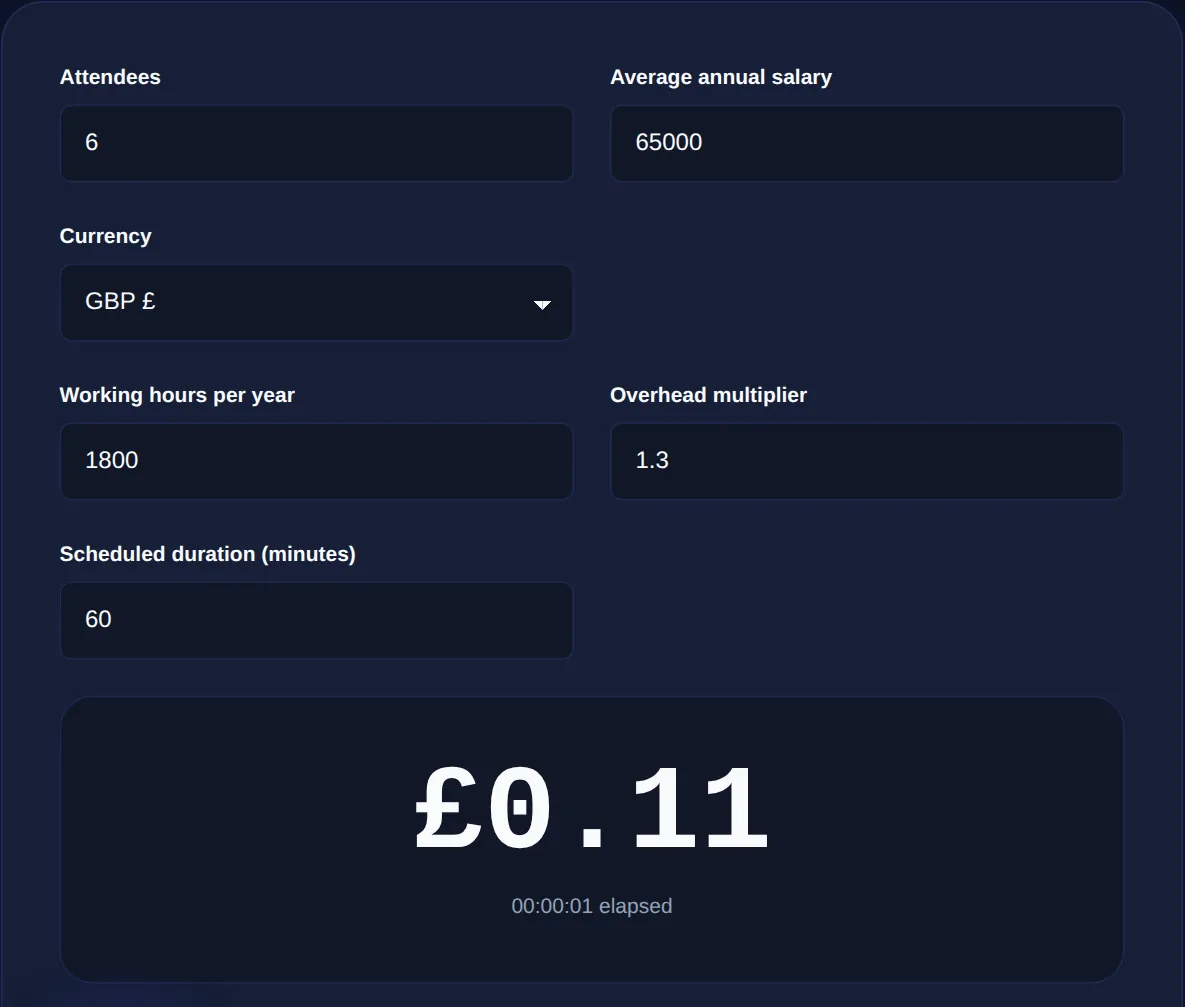
How to calculate a meeting's cost
Estimating the cost is straightforward. Take each attendee's approximate hourly cost to the organisation, their salary converted to an hourly rate, ideally loaded with the overhead that employment carries, multiply by the meeting's duration, and sum across everyone in the room. A calculator does this instantly: enter the number of people, an average hourly rate, and the length, and it returns the total. Even rough inputs produce a revealing figure, because the point is the order of magnitude, not accounting precision. Seeing that a weekly two-hour meeting of eight people costs a five-figure sum over a year reframes it entirely.
A meeting's real expense is not the room or the coffee, it is the collective attention of everyone in it, which they are not spending on other work. That opportunity cost is the true price, and it is why fewer, shorter, smaller meetings can be a genuine saving.
How the number changes behaviour
Making a meeting's cost visible tends to improve meeting culture in several ways. When people see that a gathering costs a significant sum, they ask sharper questions: does this need to be a meeting at all, or could it be a message? Does everyone invited actually need to be there, or are some attending out of habit? Could it be shorter? A price tag turns 'let's have a meeting' from a free default into a decision with a cost attached, which naturally leads to fewer unnecessary meetings, tighter agendas, shorter durations and smaller invite lists. The number does not have to be exact to have this effect; simply confronting the scale is usually enough to prompt more disciplined choices.
Making meetings worth their cost
The aim is not to eliminate meetings but to ensure they earn their price. A few practices help:
- Invite only the people who genuinely need to be there.
- Set a clear agenda and purpose, so time is not wasted working out why you are meeting.
- Keep to time, a visible timer helps a discussion stay on track.
- Default to shorter durations; work expands to fill the slot booked.
- Ask whether the outcome could be achieved asynchronously instead.
Estimate what a meeting really costs from the number of attendees, their hourly rate and the duration, entirely in your browser.
Costing time across the toolkit
Pricing a meeting is an example of turning time into a number, which connects to several other tools. A countdown timer keeps meetings to the length you costed them for; a percentage calculator helps you reason about what share of a team's time meetings consume; and for organisations spanning countries, a currency converter puts costs into a common currency. All of them share the insight that time has a value worth quantifying.
Meetings versus asynchronous alternatives
Once a meeting's true cost is visible, the most valuable question it prompts is often whether the gathering needs to be a meeting at all. Many meetings exist by default, a standing slot, a habit, a sense that important things deserve face time, rather than because a live, synchronous conversation is genuinely the best way to achieve the goal. A great deal of what happens in meetings, such as sharing updates, distributing information or gathering written input, can be done asynchronously through a document or message that people read and respond to on their own time, at a fraction of the cost, because it does not require everyone to stop and assemble at the same moment.
Synchronous meetings earn their price when the work genuinely benefits from real-time interaction: complex decisions that need back-and-forth debate, sensitive conversations, creative brainstorming that builds on live energy, or relationship-building where presence matters. The discipline that a cost figure encourages is to reserve meetings for those cases and to push everything else, status updates, simple approvals, information sharing, first-draft feedback, into asynchronous channels. This is not about never meeting; it is about matching the method to the need, so that the expensive tool of collective real-time attention is spent only where it adds value that a document cannot. Organisations that internalise this tend to hold fewer, better meetings: the ones that remain are the ones worth the considerable price, and everyone's time is freed for the focused individual work that meetings, held carelessly, so easily crowd out. Seeing the cost is what starts that shift, by turning the choice to meet from an unexamined reflex into a deliberate decision.
To sum up: meetings feel free but are among the biggest hidden costs in any organisation, because the real price is the combined value of everyone's time, a figure that multiplies fast with more people and longer durations. Calculating it, even roughly, makes that hidden cost visible, which prompts sharper decisions about whether to meet, who to invite and how long to take. Use the number not to ban meetings but to make sure each one is worth what it quietly costs, and pair it with the discipline of clear agendas, tight timing and small invite lists. Time is the most expensive thing a meeting spends, and seeing its price is the first step to spending it well.