How Your Calorie Needs Are Calculated: BMR, TDEE and Targets
Your daily calorie number comes from two pieces: the energy you burn at rest and the energy you burn moving. Here is how the calculation works, and its limits.
By Mubasher Hussain · Published 2026-09-12 · Updated 2026-09-01 · 968 words · about 4 minute read
The daily calorie figure that fitness apps and calculators give you is not a mystery number. It is built from two understandable parts: the energy your body uses just to stay alive, and the extra energy you burn by moving around. Understanding how it is put together helps you use it sensibly rather than treating it as gospel. You can work out your own numbers with the free Calorie Calculator. The figures here are general information, not medical or dietary advice.
BMR: the energy of just existing
Your basal metabolic rate, or BMR, is the number of calories your body burns at complete rest to keep everything running: your heart beating, your lungs breathing, your brain working, your cells maintaining themselves. It is the single largest part of most people's daily energy use, often around sixty to seventy percent of the total. Even if you spent an entire day lying still, you would burn roughly your BMR in calories.
Because BMR depends on your body, calculators estimate it from a few inputs: your weight, height, age and sex. More muscle and a larger body burn more at rest, BMR tends to decline gradually with age, and the formulas account for average differences between men and women. The most widely used and accurate general equation is Mifflin-St Jeor, which is what our calculator uses.
| Component | What it covers | Rough share of the day |
|---|---|---|
| BMR | Organs, cells, at rest | 60 to 70 percent |
| Activity | Movement and exercise | 15 to 30 percent |
| Digestion | Processing food | About 10 percent |
TDEE: adding your activity
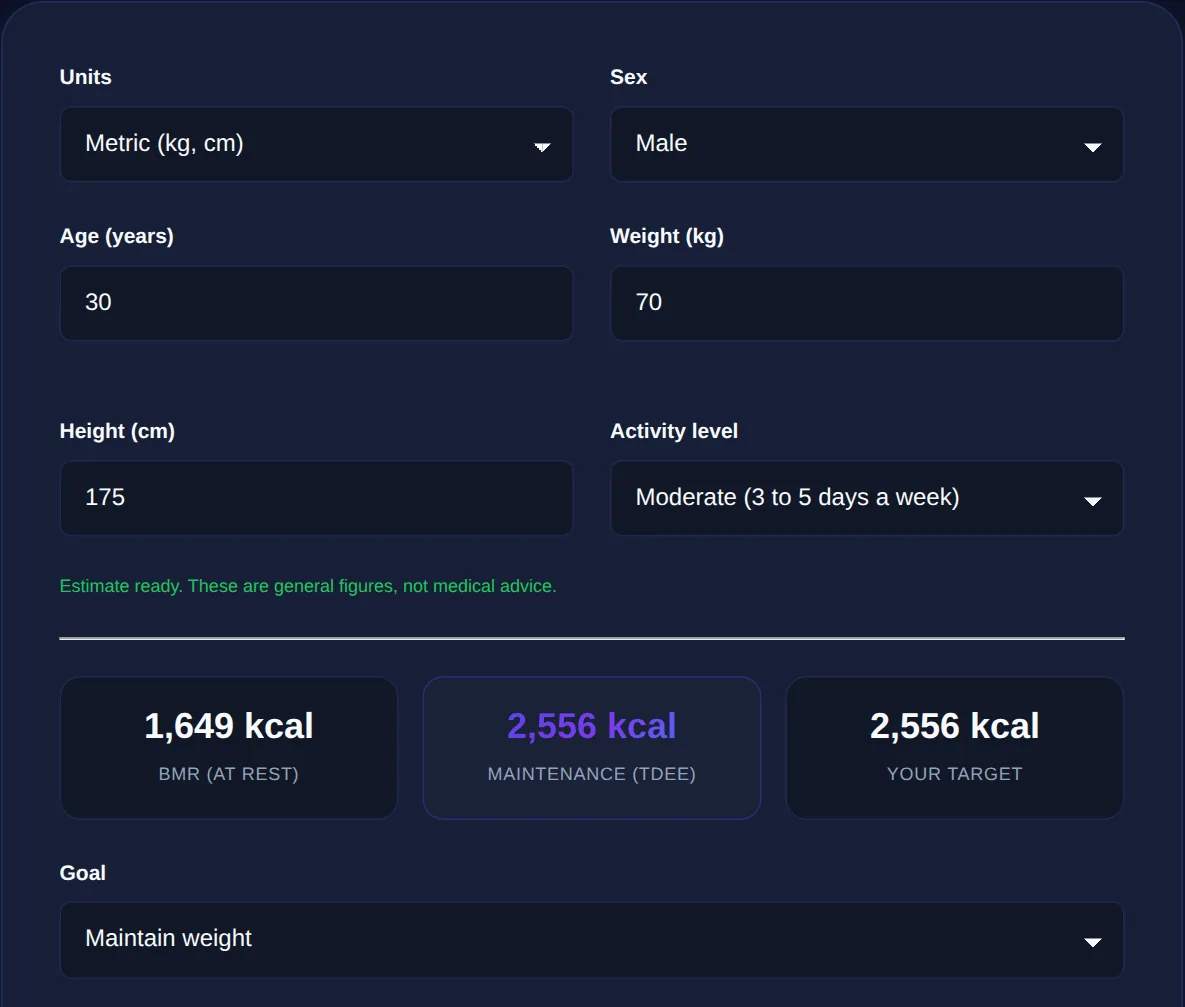
BMR is only the resting baseline. Your total daily energy expenditure, or TDEE, is what you actually burn once you include moving, exercising and even digesting food. Calculators estimate it by multiplying your BMR by an activity factor, a number that grows with how active you are. A sedentary day uses a multiplier around 1.2, a moderately active week around 1.55, and a very active lifestyle up to about 1.9. So someone with a BMR of 1,600 and a moderate activity level would have a TDEE of roughly 2,480 calories.
That TDEE figure is your maintenance level: eat about that many calories and your weight tends to stay stable over time. It is the anchor for any goal, because losing or gaining is defined relative to it.
Estimate your BMR and maintenance calories from your details and activity, then set a goal to see a daily target and a suggested macro split. Runs in your browser.
Turning maintenance into a target
To change weight, you adjust intake relative to maintenance. Eating fewer calories than you burn creates a deficit, and your body makes up the difference from its stores, so you tend to lose weight. Eating more creates a surplus, which supports gaining weight or building muscle. A widely used rule of thumb is that a deficit or surplus of about 500 calories a day corresponds to roughly half a kilogram, or about a pound, a week. A gentler quarter-kilo pace uses about 250 calories a day.
That 500-calorie rule comes from the old estimate that a pound of body fat stores about 3,500 calories. It is a useful starting point, but the body is not a simple spreadsheet: as you lose weight your BMR drops slightly, appetite and activity adjust, and the real rate of change usually slows over time. Treat the target as a direction, not a guarantee.
What the macros mean
Beyond the total, calculators often suggest how to split it across the three macronutrients. Protein and carbohydrate each provide about four calories per gram, and fat provides about nine. A common balanced starting split is something like thirty percent protein, forty percent carbohydrate and thirty percent fat, which the calculator turns into grams per day. This is one reasonable template rather than the only correct answer, and the right balance for you depends on your goals, your training and your preferences.
Every number here describes an average person. Your real metabolism, body composition, health conditions and medications can shift the figures. Use the results as a starting point, watch how your body responds over a few weeks, and adjust. If you have a health condition, are pregnant, or are planning a significant change, talk to a doctor or a registered dietitian.
Using the numbers well
The best way to use a calorie estimate is as a hypothesis to test, not a rule to obey. Start at the target, keep it consistent for two or three weeks, and see what actually happens to your weight and how you feel. If nothing changes when you expected it to, the estimate simply needs adjusting, which is normal, because no formula can perfectly predict one individual. Small, steady changes beat dramatic ones, both for results and for sticking with them.
Common questions
What is the difference between BMR and TDEE? BMR is what you burn at rest; TDEE is BMR plus everything you do in a day. Which formula is most accurate? Mifflin-St Jeor is the most reliable general equation and is what the calculator uses. How big a deficit should I aim for? A common guide is about 500 calories a day for roughly a pound a week, but gentler is often more sustainable. Is this medical advice? No, it is general information; consult a professional for personal guidance.
Your calorie number is just resting energy plus activity, with a goal adjustment on top. Estimate yours with the Calorie Calculator, and for another common health metric see what the BMI Calculator does and does not tell you.